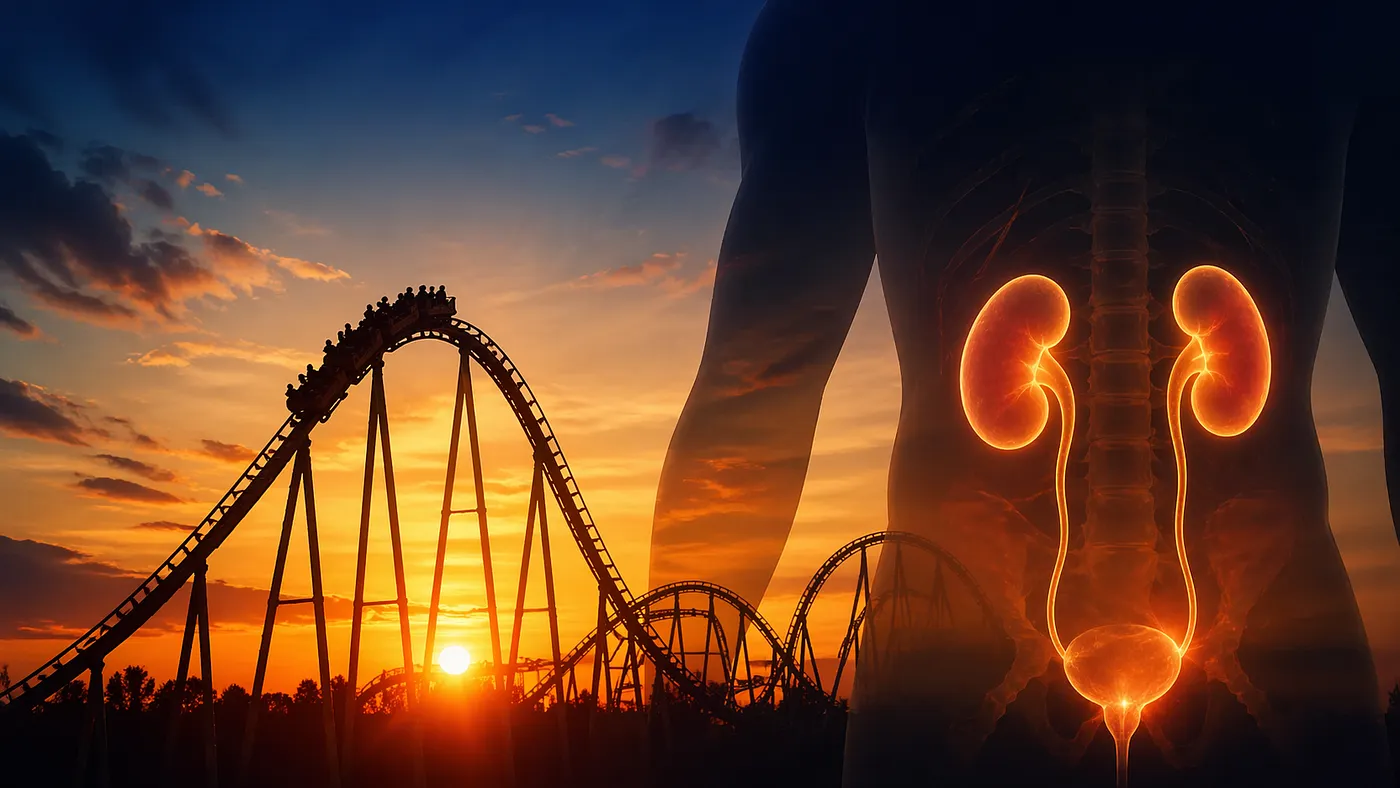
My wife was scheduled for surgery.
The pain was unbearable. The scans were clear.
Then, just days before the procedure, we went to an amusement park.
The Day Pain Took Over
It started in January 2017.
What felt like discomfort quickly escalated into something far more serious, sharp, immobilizing pain that made even simple movement difficult. A trip to the ER followed, along with temporary relief through medication.
For a few days, things seemed under control.
Then the pain came back.
The Diagnosis That Slowly Became a Decision
By mid-February, we had answers.
Blood work, urine tests, and imaging confirmed it:
A kidney stone.
At first, it felt manageable. We were prescribed medication and told there was a chance it would pass naturally.
But kidney stones don’t follow timelines.
Some pass quickly.
Some take weeks.
And some… just stay.
A later scan showed the stone was around 6–7 mm, sitting close to the bladder.
Close, but not close enough.
The Long Stretch of “Almost”
From January through May, life became a cycle:
- Pain → relief → hope → pain again
- Medication → hydration → waiting
- Trying everything people casually recommend
We tried it all:
- Increased fluids
- Home remedies (including beans juice)
- Reflexology
- Even the “drink beer” suggestion (which did not go well)
Nothing gave consistent results.
Eventually, the decision was made:
Surgery was scheduled for May.
The Question That Changed Everything
A couple of weeks before the procedure, I asked:
“What if we try one last thing?”
Not another medication.
Not another scan.
Something unconventional.
I had read about how motion, gravity, and repeated acceleration might help kidney stones move through the urinary tract.
At first, it sounded far-fetched.
Then I dug deeper, and realized there was actual science behind it.
The Science You Don’t Hear About
Studies have shown that roller coaster rides can increase the likelihood of passing kidney stones.
Why?
Because of:
- Rapid acceleration and deceleration
- Sudden directional changes
- Mechanical vibrations
- Gravitational forces (G-forces)
These forces can create subtle internal shifts, sometimes enough to dislodge a stone that’s already near the end of its path.
Think of it as giving the body a controlled “nudge.”
The Real Challenge Wasn’t the Science
It was my wife.
She’s not a fan of rides.
At theme parks, she’s usually the one holding bags while everyone else lines up for thrills.
Now I was asking her to do the exact opposite, ride the toughest ones… while already in pain.
Not an easy ask.
But with enough trust, patience, and a shared goal to avoid surgery if possible, she agreed.
The Experiment: Worlds of Fun
Around mid-May, we walked into the park with a completely different mindset.
This wasn’t about fun.
This was intentional.
She rode:
- High-speed coasters
- Sudden drops
- Sharp turns
- Repetitive, jarring movements
Each ride wasn’t random, it was purposeful.
Every motion was a chance to help the stone move.
We came home exhausted… but hopeful.
What Happened Next Changed Everything
Nothing happened immediately.
No dramatic moment.
No instant relief.
We slept.
Then, within a few days, something incredible happened.
In the middle of the night, she woke me up.
In her hand was a tiny object.
The stone.
It had finally passed.
The relief on her face said everything.
The next morning, we called the doctor and cancelled the surgery.
Even they were surprised.
So… Did Roller Coasters Actually Work?
Let’s stay grounded.
This is not a guaranteed solution.
What likely happened was a combination of factors:
- Weeks of hydration
- Medication doing its job
- Natural progression of the stone
- And possibly… the rides acting as the final push
The rides didn’t “fix it.”
They may have finished it.
What This Experience Taught Me
We often think solutions are:
- Linear
- Predictable
- Controlled
But real life doesn’t work that way.
Sometimes:
- Medicine prepares the path
- Time does the work
- And something unexpected… completes the journey
If You’re Dealing With Kidney Stones
Here’s the practical takeaway:
- Stones under ~5 mm often pass naturally
- Stones around 6–7 mm are borderline (like ours)
- Larger stones may require intervention
If you’re exploring options:
- Always consult your doctor
- Understand the stone’s size and position
- Don’t delay necessary procedures
But in certain cases:
Movement might help, especially when the stone is already close.
The Moment That Stayed With Me
It wasn’t the rides.
It wasn’t even the science.
It was that quiet moment,
in the middle of the night,
when pain turned into relief.
No surgery.
No machines.
Just a tiny stone… and a deep exhale.
This isn't a prescription — it's a story about one borderline stone, months of conventional treatment doing most of the work, and an unconventional final push that may or may not have been the deciding factor. The roller coaster research is real: repeated G-forces and rapid directional changes have been shown to help dislodge small kidney stones near the ureter. But that's most relevant for stones already close to passing on their own. What's genuinely useful from this experience is simpler: stay medically supervised, trust the process, hydrate consistently, and don't close your mind to unconventional options when conventional ones are running out of road.
ETL Takeaway (Eat • Train • Lead)
E → Eat
Hydration is not optional, it’s foundational.
T → Train
Movement isn’t just fitness. Sometimes, it’s functional.
L → Lead
Leadership shows up in uncertain moments, guiding with courage, not certainty.
Disclaimer
This is a personal experience, not medical advice. Kidney stones vary in size, type, and risk. Always consult a qualified healthcare professional before trying alternative approaches.
What I'd Actually Do
- If you're dealing with a kidney stone, hydration is the single most evidence-backed intervention: 2–3 liters of water daily. Start there before anything else.
- Understand your stone's size and position before making any decisions. Under 5mm usually passes on its own. 6–7mm is borderline. Over 8mm typically needs medical intervention — don't gamble with that.
- If your stone is already near the bladder and small enough that natural passage is realistic, gentle movement (walking, light bouncing, or in extraordinary cases, rides) may help. But work with your urologist, not around them.
- Follow your prescribed medication protocol fully. Alpha-blockers like tamsulosin are genuinely effective at relaxing the ureter — the medication was doing most of the work in our case.
- Trust the timeline, not the urgency. Kidney stones rarely move on a schedule. The 4-month arc in this story is not unusual — and premature surgery before natural passage is fully exhausted is a real risk.
- Talk to a urologist — not the internet — before making decisions about kidney stone management. Stone type, size, location, and your overall health all affect what approach is appropriate for you specifically.