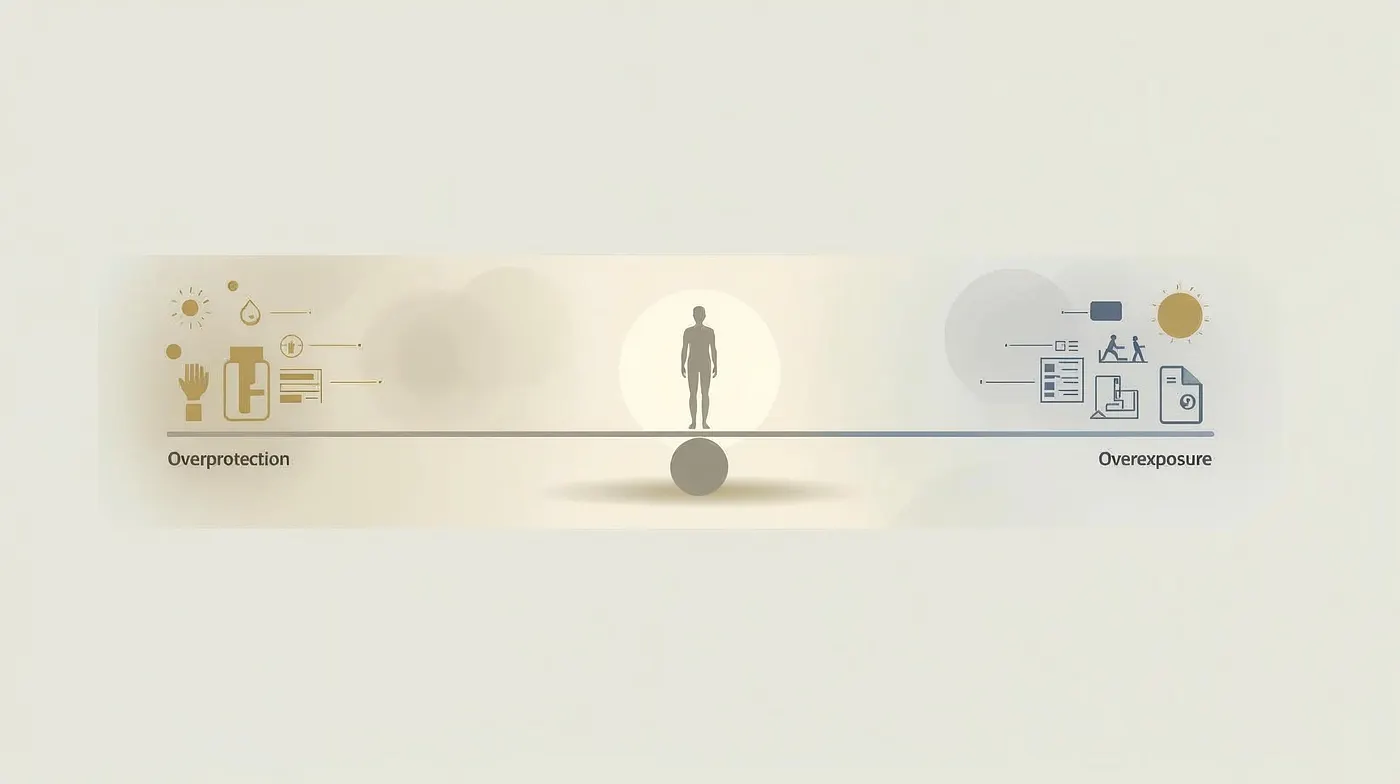
Humans rarely fail because they do too much or too little.
They fail because they swing wildly between both.
From sunscreen to screen time, modern life quietly pushes us toward extremes. And the more we try to fix problems, the more we tend to overcorrect.
But biology, psychology, and performance science all point to the same truth:
The healthiest outcomes rarely live at the edges.
They live in a narrow band, the Goldilocks Zone.
Understanding why humans swing between overexposure and overprotection may be one of the most important life skills in the modern world.
The Human Pattern: Overcorrecting
Humans are natural over-correctors.
When we detect a risk, we don’t just adjust slightly.
We often swing in the opposite direction.
For example:
- Fear of skin cancer → avoid sunlight entirely
- Fear of germs → hyper-sterile environments
- Fear of injury → avoid physical activity
- Fear of financial loss → avoid investing
But biology, psychology, and performance science all point to the same truth:
Optimal living happens in the middle.
The “Goldilocks Zone” of Human Life
In science, there is a concept called the Goldilocks Zone.
Not too little.
Not too much.
Just right.
This principle appears everywhere in nature:
- The Earth’s distance from the sun
- Body temperature regulation
- Hormone balance
- Nutrient intake
The same rule applies to everyday behaviors.
Let’s look at where humans most commonly fall into extremes.
1. Sunlight: Fear vs Exposure
Sunlight has become one of the most debated health topics.
Overexposure
- Sunburn
- Skin aging
- Increased skin cancer risk
- Collagen breakdown
Overprotection
- Vitamin D deficiency
- Hormonal disruption
- Poor immune function
- Mood decline
Sunlight is both medicine and stress.
The solution isn’t elimination, it’s dose control.
Balanced approach
- 10–20 minutes of natural sunlight daily
- Protect during peak UV hours
- Use sunscreen when exposure exceeds safe levels
2. Hygiene: Clean vs Sterile
Cleanliness saves lives.
But hyper-sterile environments may also weaken immune systems.
Scientists call this the Hygiene Hypothesis.
Overexposure
- Infectious disease
- Foodborne illness
- Environmental toxins
Overprotection
- Higher allergies
- Immune hypersensitivity
- Autoimmune disorders
Children raised in environments with natural microbial exposure often develop stronger immune responses.
Balanced approach
- Good sanitation practices
- Natural environmental exposure
- Outdoor play and interaction with nature
3. Exercise: Stress vs Adaptation
Exercise is a powerful biological signal.
But like all stress, it follows a curve.
Overexposure
- Overtraining
- Chronic fatigue
- Joint damage
- Elevated cortisol
Overprotection
- Muscle loss
- Metabolic decline
- Increased disease risk
- Reduced lifespan
The body needs challenge, but also recovery.
Balanced approach
- Strength training 3–5 days per week
- Regular walking or light cardio
- Sleep and recovery prioritized
4. Nutrition: Excess vs Restriction
Food is another area where humans swing wildly.
Overexposure
- Processed foods
- Constant snacking
- Calorie overload
Overprotection
- Extreme dieting
- Nutrient deficiencies
- Hormonal disruption
- Metabolic slowdown
The healthiest diets usually share one principle:
Nutrient density over restriction.
Balanced approach
- Whole foods
- Adequate protein
- Controlled carbohydrates
- Natural fats
5. Technology: Hyperconnected vs Disconnected
Technology is one of the newest environments humans must navigate.
Overexposure
- Social media addiction
- Reduced attention span
- Mental fatigue
- Sleep disruption
Overprotection
- Digital illiteracy
- Missed opportunities
- Social isolation
Technology should be a tool, not an environment we drown in.
Balanced approach
- Intentional screen time
- Deep work periods
- Digital detox windows
6. Parenting: Risk vs Resilience
Modern parenting shows another extreme swing.
Overexposure
- Unsafe environments
- Lack of boundaries
- Poor guidance
Overprotection
- Helicopter parenting
- Anxiety in children
- Reduced resilience
Children build confidence through managed risk.
Climbing trees, solving problems, failing occasionally, these experiences develop independence.
Balanced approach
- Supervised exploration
- Age-appropriate responsibility
- Encouraging problem-solving
The Biological Principle Behind Balance
The reason balance matters is a concept called Hormesis.
Hormesis describes how small stress improves health.
Examples include:
- Exercise
- Sunlight
- Cold exposure
- Fasting
- Learning challenges
A small dose of stress triggers adaptation.
But two things break the system:
- Too much stress → damage
- Too little stress → decline
The body thrives in the middle zone.
How to Measure Your Balance
Instead of guessing, you can monitor three signals.
1. Exposure
How much stimulus are you receiving?
Examples:
- Sunlight hours
- Training sessions
- Screen time
2. Recovery
How well do you bounce back?
Examples:
- Sleep quality
- Energy levels
- Mood stability
3. Adaptation
Are you improving?
Examples:
- Strength gains
- Mental clarity
- Immune resilience
If exposure exceeds recovery, burnout follows.
If exposure never reaches adaptation levels, growth never happens.
The Leadership Parallel
This principle doesn’t just apply to health.
It applies to organizations and leadership.
Leaders often oscillate between:
- Micromanagement (overprotection)
- Total autonomy (overexposure)
Great teams operate differently.
They build guardrails with freedom.
Clear structure.
Room to innovate.
The Real Skill of Modern Life
The modern world pushes us toward extremes.
Extreme diets.
Extreme productivity.
Extreme safety.
Extreme stimulation.
But nature rarely rewards extremes.
It rewards balance.
The Simple Rule to Remember
Before increasing exposure or adding protection, ask:
- What is the optimal range?
- What signals show I’ve crossed it?
- What feedback loop am I tracking?
Life works best not at the edges, but in the middle where adaptation happens.
Final Thought
Imagine life like a thermostat.
Too cold → nothing grows.
Too hot → things burn.
But within the right range, systems thrive.
Health, resilience, and performance don’t come from avoiding stress.
They come from finding the narrow band where challenge and recovery meet.
That band is where humans grow strongest.
The overexposure trap shows up in every domain — fitness, nutrition, screen time, parenting, sunlight — and modern culture makes it easy to keep swinging. The hormesis principle isn't just biology trivia; it's a practical operating framework. The question worth asking about every behavior isn't "more or less?" but "what's the signal that I've crossed the optimal range?" Once you have that signal, you can self-correct rather than wait for burnout or injury to do it for you.
The ETL Takeaway
Eat — Nutrition thrives in the middle zone.
Train — The body grows through stress + recovery.
Lead — Leadership also lives in the middle.
Before changing any behavior, ask:
- Am I underexposed or overexposed?
- What does the optimal range look like?
- What signal tells me I’ve crossed it?
Disclaimer
This article is intended for educational and informational purposes only and should not be interpreted as medical or professional advice. Individual health conditions and circumstances vary, so consult qualified professionals before making significant lifestyle changes.
Not sure whether to train or rest today? Three honest inputs, one clear answer.
Check your recovery →What I'd Actually Do
- Pick one behavior this week and run the three-signal check: What is my current exposure level? How well am I recovering from it? Am I actually adapting (improving), or just repeating? That audit is more useful than any optimization article.
- For training specifically: track subjective energy and mood for two weeks. If you're consistently dragging on training days, you're likely overexposed. If you never feel challenged, you're underexposed. Adjust dosage, not willpower.
- For nutrition: before adding another restriction, ask whether what you need is actually more nutrient density rather than less food. Most people who plateau need more not less — they just need better quality input.
- Set one intentional digital boundary this week — a specific time window with no screen access. You don't need to "detox"; you need a dose-controlled relationship with technology.
- For sunlight: get 10–20 minutes of morning sun daily without sunscreen (arms or legs), then apply protection if you're staying out longer. That's the Goldilocks approach in practice.
- Talk to a clinician if you have chronic fatigue, are recovering from overtraining syndrome, or have an autoimmune condition that may be affected by environmental exposures.