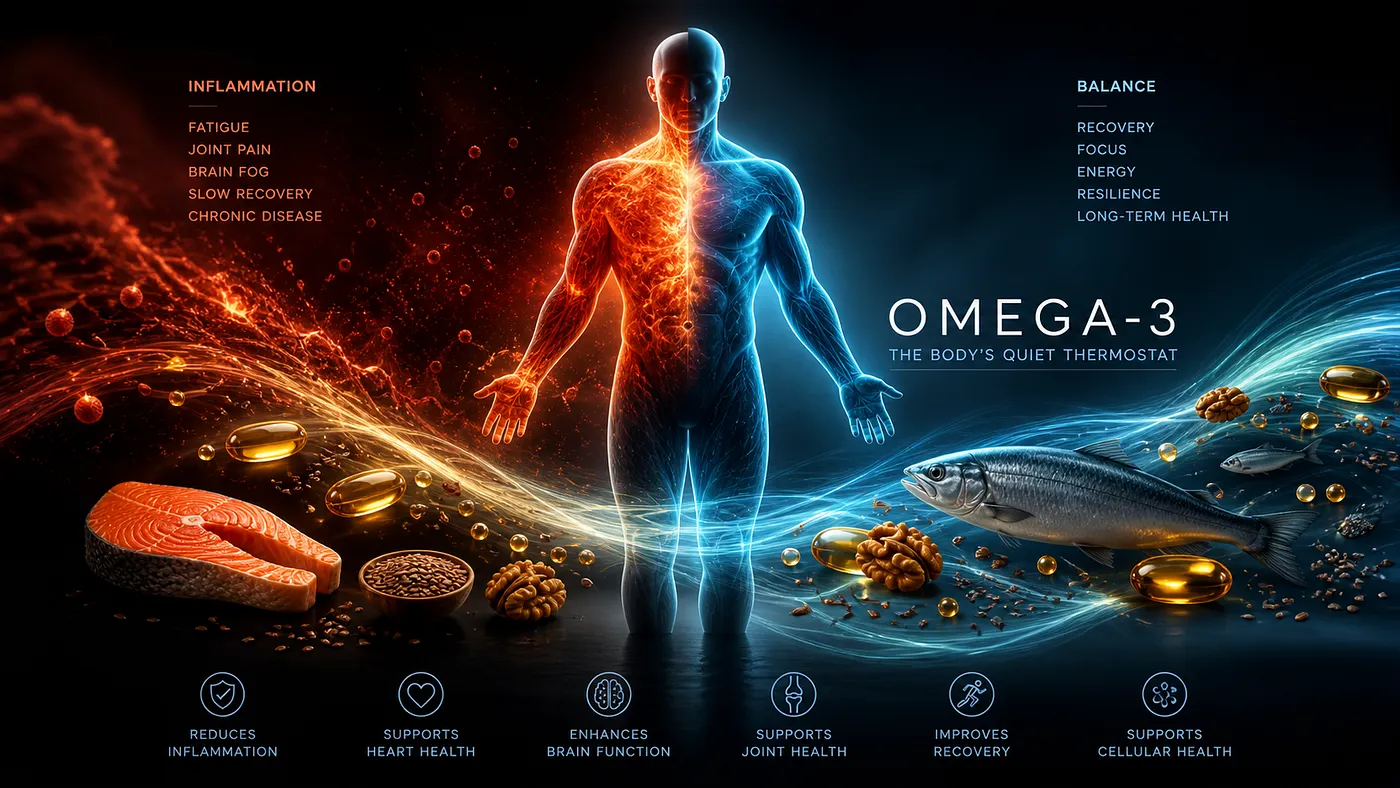
The Fire You Don’t Feel
Inflammation isn’t always dramatic.
It doesn’t always show up as pain, swelling, or fever.
Most of the time, it’s low-grade, chronic, and silent.
It hides behind:
- Persistent fatigue
- Stubborn belly fat
- Joint stiffness “from age”
- Brain fog
- Slow recovery after workouts
- Gradual metabolic decline
Chronic inflammation is the common soil beneath heart disease, diabetes, arthritis, autoimmune issues, cognitive decline, and accelerated aging.
And one of the most powerful regulators of this silent fire is Omega-3 fatty acids.
Not as a drug.
Not as a quick fix.
But as a biological moderator.
What Omega-3 Really Does (Beyond the Buzz)
Omega-3s are essential fatty acids, meaning your body cannot make them. You must consume them.
But their real magic lies in how they work.
Omega-3s don’t “block” inflammation
They rebalance it.
Your immune system needs inflammation to heal and defend.
The problem is when the off-switch breaks.
Omega-3s help:
- Shift inflammatory signaling pathways
- Produce “resolvins” and “protectins” (molecules that actively end inflammation)
- Counterbalance excessive omega-6 intake
- Improve cell membrane flexibility and signaling
Think of Omega-3 not as water on fire, but as a thermostat resetting the room.
The Omega-3 Family (Know the Difference)
Not all Omega-3s are equal.
ALA (Alpha-Linolenic Acid)
- Found in flaxseeds, chia seeds, walnuts
- Poorly converted to EPA & DHA (often <10%)
EPA (Eicosapentaenoic Acid)
- Anti-inflammatory powerhouse
- Strong cardiovascular and metabolic benefits
DHA (Docosahexaenoic Acid)
- Structural fat for the brain and eyes
- Critical for cognition, mood, and nervous system health
EPA + DHA are where most clinical benefits live.
Plant sources are helpful, but marine sources are superior.
Inflammation, Fitness, and Recovery
This is where Omega-3 quietly shines, especially if you train.
- Reduces exercise-induced muscle damage
- Improves joint lubrication and mobility
- Enhances protein synthesis response
- May improve VO₂ max and endurance markers
- Supports faster recovery without blunting adaptation (unlike NSAIDs)
If you train hard but recover poorly, inflammation may not be your enemy, poor regulation is.
Brain, Mood, and Mental Clarity
Your brain is ~60% fat.
A significant portion of that is DHA.
Low Omega-3 status is linked with:
- Depression
- Anxiety
- ADHD
- Cognitive decline
Omega-3s support:
- Neurotransmitter function
- Reduced neuroinflammation
- Better stress resilience
- Improved sleep quality
Mental clarity isn’t just mindfulness, it’s biochemistry.
The Modern Diet Problem
We evolved on an omega-6 : omega-3 ratio close to 1:1.
Modern diets push this ratio to 15–25:1.
Sources of excess omega-6:
- Seed oils (corn, soybean, sunflower)
- Ultra-processed foods
- Restaurant and fast foods
This imbalance amplifies inflammatory signaling.
Adding Omega-3 helps, but reducing omega-6 overload matters too.
How Much Omega-3 Do You Really Need?
General evidence-based guidance:
EPA + DHA combined:
- Maintenance: 1–2 g/day
- Inflammation management: 2–4 g/day (under guidance)
Food sources (best):
- Fatty fish (salmon, sardines, mackerel): 2–3x/week
Supplement tips:
- Look for third-party tested
- Triglyceride or re-esterified TG forms preferred
- Check EPA/DHA amounts, not just “fish oil mg”
Who Should Take Omega-3 (and Who Should Be Careful) — Simple Decision Framework
Ask yourself:
- Do I eat fatty fish regularly?
- Do I deal with inflammation, stress, or heavy training?
- Is my diet heavy in processed foods?
If “yes” to any → Omega-3 likely helps
But also ask:
- Am I on blood thinners?
- Do I have a medical condition affecting clotting?
If “yes” → Talk to a professional first
When Omega-3 Is Not a Magic Pill
Omega-3 won’t:
- Cancel poor sleep
- Offset ultra-processed diets
- Replace movement
- Fix chronic stress
But when layered into a clean lifestyle, it becomes a force multiplier.
A Personal Reflection
I didn’t notice Omega-3 working the way caffeine works.
There was no “kick.”
What I noticed, weeks later, was:
- Less joint stiffness in the morning
- Faster recovery after workouts
- Calmer focus during long workdays
- Fewer inflammatory flare-ups
That’s when I realized:
The most powerful regulators don’t announce themselves.
They stabilize.
A Simple, Clean Option I Personally Use
One option that has worked well for me is Sports Research Omega-3 Fish Oil.
It checks the boxes that actually matter:
- High EPA + DHA per serving (so you’re not taking multiple capsules)
- Sourced from wild Alaska pollock
- MSC-certified sustainable, non-GMO, and soy-free
- Third-party tested for quality and purity
What I like most is the dose efficiency, you get a meaningful amount of Omega-3 without overcomplicating your routine.
If you want to explore the same option, you can find it here:
https://amzn.to/4uvLeTw
Note: I may earn a small commission if you purchase through any of the above links, at no extra cost to you. I only share products I’ve personally used or carefully evaluated.
Simple Buying Rule (If You Remember Nothing Else)
Look for this combo:
- ≥1000 mg EPA + DHA per serving
- Triglyceride form
- Third-party tested
- No fishy aftertaste
Eat · Train · Lead Takeaways
Eat: Choose fats that reduce friction, not create it.
Train: Recover smarter, not just harder.
Lead: Make long-term decisions that compound quietly.
Inflammation isn’t loud when it ruins lives.
Omega-3 isn’t loud when it protects them.
Key Takeaways (SMART & Practical)
- Specific: Aim for 2 servings of fatty fish weekly or 1–2 g EPA+DHA daily
- Measurable: Track joint pain, recovery time, and mental clarity over 30 days
- Achievable: Add Omega-3 before adding more supplements
- Relevant: Especially critical if you train, age 35+, or work high-stress jobs
- Time-bound: Reassess benefits after 8–12 weeks
Final Thought
Omega-3 doesn’t fight inflammation.
It teaches your body when to stop fighting.
And that may be the most intelligent form of health there is.
Omega-3 is one of the few supplements with a genuinely strong evidence base — not for dramatic effects, but for quietly doing what a broken modern diet can't: restoring a ratio your biology was designed to work with. The benefits (less joint stiffness, faster recovery, calmer focus) don't announce themselves. They show up weeks later, almost imperceptibly. That's exactly how the best regulators work. If you eat fatty fish twice a week, you may not need a supplement. If you don't, 1–2g EPA+DHA daily is worth taking seriously.
Disclaimer
This article is for educational and informational purposes only and is not intended as medical advice. Nutritional needs and supplement responses vary by individual. Always consult a qualified healthcare professional before making dietary changes, starting supplements, or adjusting dosages, especially if you have underlying health conditions, are pregnant, or are taking prescription medications.
See how this fits into a simple, evidence-based daily stack.
See the ingredient stack →What I'd Actually Do
- Eat fatty fish (salmon, sardines, mackerel) at least twice a week. This is the food-first baseline before any supplement conversation happens.
- If you're not hitting that, look for a fish oil supplement with at least 1000mg combined EPA+DHA per serving — check the actual EPA/DHA numbers on the label, not just "fish oil mg."
- Take it with a meal that contains fat. Omega-3 is fat-soluble; absorption is measurably better with food, and it reduces the fishy aftertaste.
- Reduce seed oil exposure at the same time — the omega-6:omega-3 ratio matters as much as total omega-3 intake. Corn, soybean, and sunflower oils in processed food are the main drivers of the imbalance.
- Give it 8–12 weeks before evaluating. Track joint comfort, sleep quality, and post-workout recovery time. These are the reliable early signals.
- Talk to a clinician if you're on blood thinners, have a clotting condition, or are taking other medications — omega-3 has real interactions worth knowing about at higher doses.