It Started with a Simple Habit
Like most people trying to do the right thing for their health, I started taking Vitamin D.
Nothing dramatic. Just a small capsule in the morning, especially during the darker months. I had read enough to know that Vitamin D supports immunity, mood, and bone health. It felt like a responsible choice. Almost automatic.
And for a while, I didn't question it.
But then something interesting happened.
Not a symptom. Not a problem.
Just a quiet realization:
If Vitamin D is so powerful…, why didn't it feel complete?
That question led me down a path that most people never explore.
The First Layer: Understanding Vitamin D3
Vitamin D3, is something your body is designed to make.
Step into sunlight, and your skin begins producing it. It's elegant. Efficient. Natural.
But modern life has quietly disrupted that system.
We work indoors. We drive instead of walk. We protect our skin (rightly) with sunscreen. And suddenly, something we were meant to generate daily becomes something we have to supplement.
Vitamin D3 steps in to:
- Help your body absorb calcium
- Support bone density
- Regulate parts of your immune system
- Influence hormones and mood
On paper, it sounds like a hero nutrient.
But here's what most people don't realize:
Vitamin D doesn't "use" calcium. It only helps you absorb it.
And that distinction changes everything.
The Missing Piece Nobody Talks About
Imagine this.
You've just opened the gates and allowed more calcium into your bloodstream (thanks to Vitamin D3).
Now ask yourself:
Where does that calcium go?
If your body had a GPS system for nutrients, this wouldn't be a concern. But it doesn't, at least not automatically.
That's where Vitamin K2 comes in.
K2 doesn't get the spotlight. It's not marketed heavily. It doesn't have the same "sunshine vitamin" appeal.
But functionally?
It might be even more important in this equation.
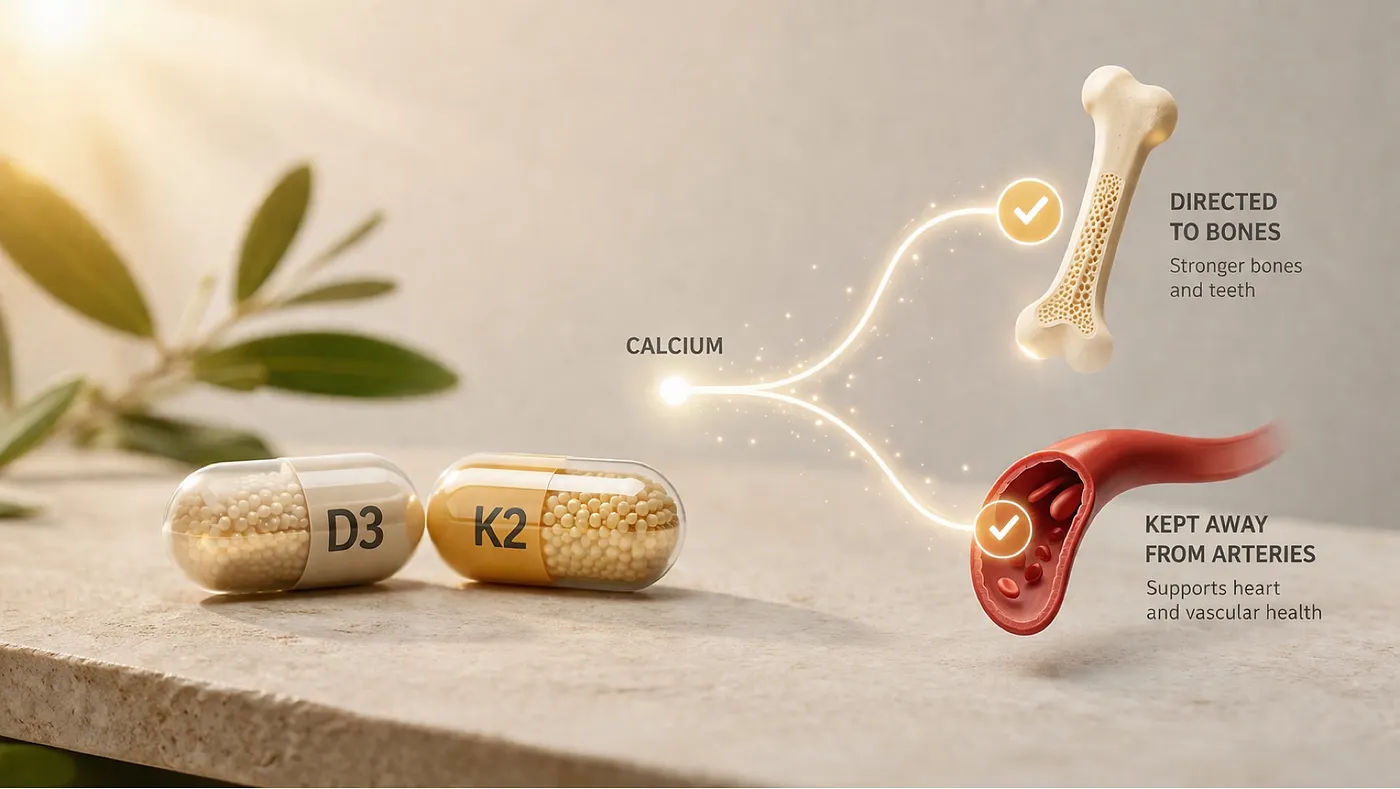
Vitamin K2 activates specific proteins, that act like traffic controllers.
They guide calcium:
- Into your bones and teeth (where it belongs)
- Away from your arteries and soft tissues (where it doesn't)
Without K2, calcium can become directionless. And your body pays the price for that confusion over time.
The Subtle Risk of "Doing the Right Thing"
Here's the paradox.
You start taking Vitamin D3 for better health.
Your body absorbs more calcium.
But without K2?
That calcium may not end up strengthening your bones.
Instead, some of it can begin settling in places you don't want, like arteries.
This isn't about fear. It's about context.
Because health isn't just about what you take.
It's about how things work together.
When D3 Meets K2 (And Why It Feels Different)
The moment you understand the relationship between D3 and K2, something clicks.
It's no longer about supplements.
It's about systems.
D3 brings calcium into circulation.
K2 ensures it reaches the right destination.
Together, they create a loop that actually makes sense.
People who start combining them often don't describe it as a "boost."
They describe it as alignment.
- Joints feel more supported
- Recovery feels smoother
- There's a subtle confidence in knowing your body isn't just absorbing, but using nutrients correctly
Who This Actually Matters For (Important)
Not everyone needs to rush into supplementation.
But if you recognize yourself in any of these, it's worth paying attention:
- You spend most of your time indoors
- You're over 40 and thinking about long-term bone health
- You train regularly and care about recovery
- You've been told your Vitamin D levels are low
- You follow a diet that may lack fat-soluble nutrients
On the other hand, there are situations where caution matters.
If you're on prescription medications, especially those related to blood thinning, or have high blood calcium levels, have kidney disease or kidney stones history, or have existing health conditions, it's a good idea to check with a healthcare professional before adding supplements like D3 or K2.
This is where personalization matters more than general advice.
The Small Details That Make a Big Difference
What surprised me most wasn't just what to take, but how to take it.
Both Vitamin D3 and K2 are fat-soluble.
Meaning?
Taking them with a low-fat meal is like trying to absorb sunlight through a closed window.
Once I started pairing them with meals that included healthy fats, eggs, fish, even a bit of olive oil, the difference in consistency and routine became effortless.
Timing didn't need to be complicated. Morning or midday worked best.
What mattered more was consistency.
How Much Is Enough (Without Overdoing It)
This is where many people go wrong.
More is not better. Better is better.
A reasonable daily range looks like:
- Vitamin D3: 1,000–2,000 IU (higher if deficient, guided by labs)
- Vitamin K2 (MK-7): 90–120 mcg
But numbers alone don't tell the full story.
If you really want to understand your baseline, a simple blood test, 25(OH)D, can give you clarity.
Because the goal isn't to chase a number.
It's to find your optimal range, where your body functions at its best.
What I Personally Use (And why)
After trying a few options, I settled into something simple and consistent from Sports Research Vitamin D3 + K2 Plant-Based Softgels
Here's why I like it:
- Uses plant-based D3 (lichen-derived)
- Combined D3 + K2 supplements are around (D3: 2,500 IU, K2: ~100 mcg)
- Includes K2 in MK-7 form (better absorption, longer lasting)
- Delivered in a softgel with coconut oil (helps absorption)
- Clean label, no unnecessary fillers
Here's the link to use: https://amzn.to/4ueXis2
I take one softgel after breakfast, usually with eggs, yogurt, and some healthy fats.
It fits seamlessly into my routine, which matters more than anything.
Note: If you buy through this link, I may earn a small commission at no extra cost to you.
Food, Sunlight, and the Forgotten Basics
Before supplements, there was lifestyle.
And it still matters.
Sunlight exposure, even 10–20 minutes, can shift your Vitamin D levels meaningfully.
Foods like:
- Fatty fish
- Egg yolks
- Fermented foods (like natto, rich in K2)
…all contribute to the bigger picture.
Supplements should support your lifestyle, not replace it.
The Real Lesson (That Goes Beyond Vitamins)
This journey changed how I look at health.
Not as a checklist.
Not as isolated habits.
But as connected systems.
Vitamin D3 + K2 isn't just about bones or arteries.
It's a reminder that:
The body doesn't operate in silos.
And neither should we.
ETL Takeaway (Eat · Train · Lead)
- Eat: Prioritize synergy over single nutrients
- Train: Strong structure comes from proper mineral balance
- Lead: Understanding your body is the ultimate form of self-leadership
Disclaimer
This content is for educational purposes only and not medical advice. Consult a healthcare professional before starting supplements, especially if you have medical conditions or take medications.
D3 without K2 is an incomplete protocol — the mechanism is real and the risk of unguided calcium deposition in soft tissues is worth taking seriously if you're supplementing D3 at meaningful doses long term. The good news: combined D3+K2 supplements exist, they're inexpensive, and the only thing that changes in your routine is which capsule you take with breakfast. Get a 25(OH)D blood test once a year and let the lab tell you whether you need to dose higher than 2,000 IU.