It Started Quietly
It began without warning.
No stress spike. No late-night caffeine. No obvious disruption I could point to and say, that’s it. My evenings were predictable, dinner at a reasonable hour, a bit of winding down, and then bed. Sleep came easily, almost effortlessly.
And then, one night, I woke up.
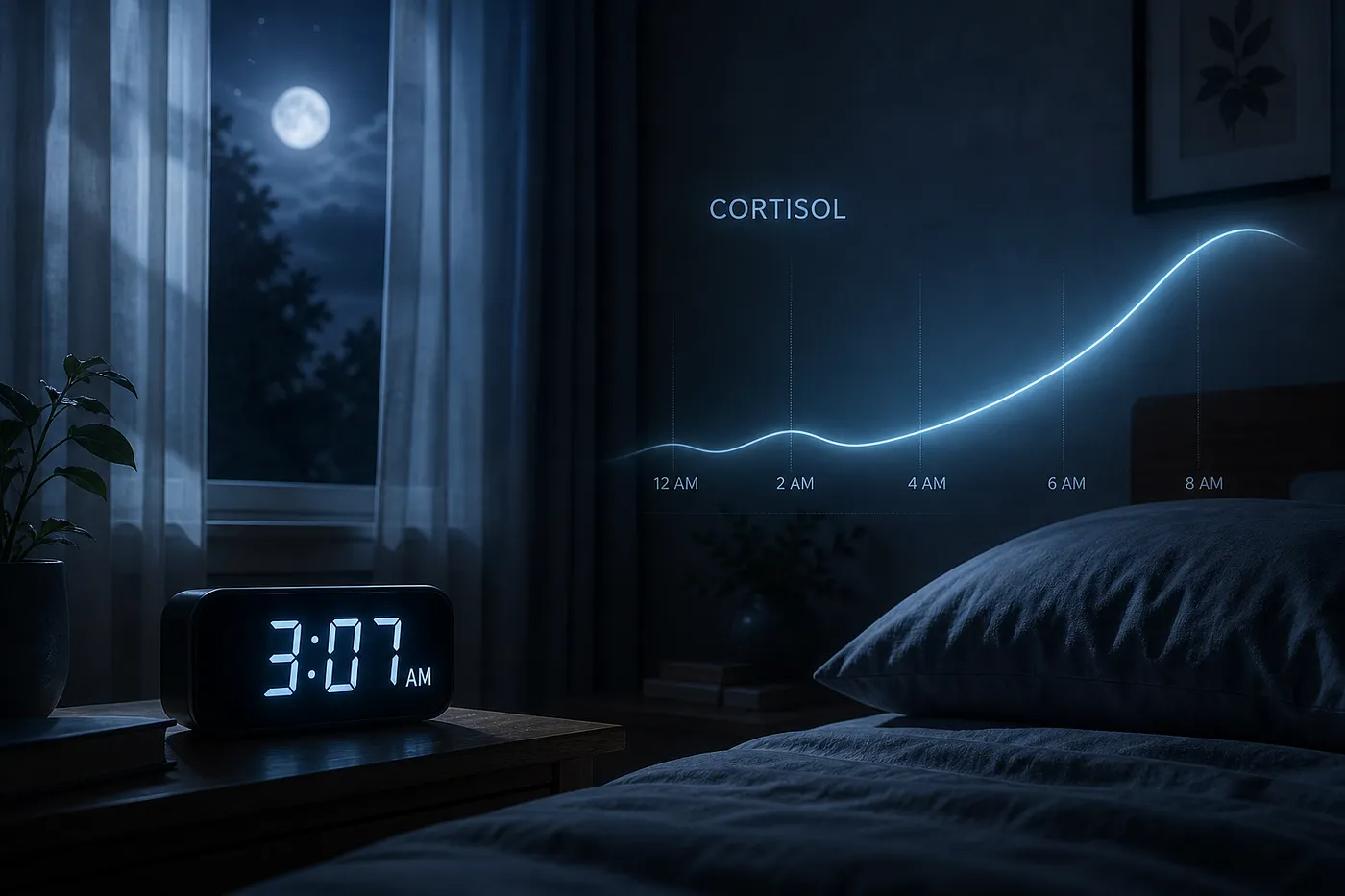
I remember glancing at the clock — 3:07 AM.
The next night, it happened again.
3:02. Then 3:11. Close enough to feel like a pattern, but not precise enough to be mechanical. It didn’t feel random. It felt… biological.
At first, I brushed it off. Everyone has an off night. Then a few more nights passed. And before long, it became something I quietly expected.
Not something I talked about. Just something I noticed.
The Frustrating Part Isn’t Waking Up
What made it frustrating wasn’t the waking itself.
It was what came after.
There I was, lying in the dark, body completely calm, but my mind alert, almost as if someone had flipped a switch internally. Not anxious. Not restless. Just… awake.
And if you’ve experienced this, you know the feeling.
You’re not tired enough to sleep.
But you’re not awake enough to function.
You’re stuck somewhere in between.
And the harder you try to fall back asleep, the further it slips away.
The Obvious Assumption (And the Trap I Fell Into)
Like most people, I went straight to the usual explanation:
“It must be melatonin.”
That’s what we’ve been conditioned to believe. Sleep equals melatonin. If sleep is off, melatonin must be low.
This is the supplementation trap. When you take 5mg or 10mg of melatonin nightly, your pineal gland, sensing the flood of exogenous hormone, downregulates its own output. You become dependent on a pill that never addressed the issue in the first place, while quietly undermining your natural melatonin factory.
Long-term reliance on high-dose melatonin can actually suppress the body’s natural production, the very system you’re trying to heal.
So I did what seemed logical. I experimented. Adjusted timing. Tried different doses. Paid attention to what worked and what didn’t.
And to be fair, it helped at first.
Falling asleep became easier. Nights felt smoother.
But the 3 AM wake-ups?
They didn’t go away.
They just became more predictable.
That’s when something didn’t add up.
If melatonin was the answer, why was my body still waking me up at the same time every night?
The Accidental Shift
The breakthrough didn’t come from trying harder.
It came from not trying at all.
Around that time, I had started making a few subtle changes, not specifically for sleep, but just to feel better overall. I began leaning toward lighter dinners. I found myself reaching for something warm in the evenings. I became a bit more consistent about stepping away from screens and easing into the night.
Nothing dramatic. Nothing I would have labeled as a “solution”.
And then one morning, I woke up… at 6:00 AM.
No interruption. No memory of waking up in the middle of the night. Just a full, uninterrupted stretch of sleep.
It caught me off guard.
Not because I had fixed it, but because I hadn’t tried to fix it.
What I Was Missing All Along
That moment led me to a simple but powerful realization:
This wasn’t about melatonin.
It was about timing.
More specifically, it was about cortisol.
We often hear cortisol described as the “stress hormone,” but that’s only part of the story. It’s also your body’s natural alertness signal, the thing that helps you wake up in the morning.
In a healthy rhythm, cortisol rises gradually as the sun comes up.
But if that rise happens too early?
Your body doesn’t question it.
It simply responds.
Cortisol goes up → your brain wakes up.
And suddenly, 3 AM feels like morning.
Why This Happens More With Age
As we move into our 50s and beyond, subtle shifts begin to take place.
The nervous system becomes a bit more sensitive. Recovery from stress isn’t as quick. Blood sugar can fluctuate overnight. Inflammation, even at low levels, can linger in the background.
None of these changes are dramatic on their own.
But together, they create a perfect storm, one where cortisol can rise earlier than it should.
And when it does, your sleep follows.
Not because something is broken.
But because something is misaligned.
What Actually Changed for Me
When I looked back at what had shifted, it became clear:
I hadn’t treated sleep directly.
I had supported the systems around sleep.
The lighter dinners reduced late-night metabolic stress. The warm evening routine signaled my body to slow down. The consistency helped my nervous system settle into a rhythm it could trust.
I hadn’t forced sleep.
I had removed the reasons for waking up.
The Five Tablespoons That Changed How I Thought About Sleep
That’s when I came across a simple idea that made the whole experience easier to understand.
Not a supplement stack.
Not a sleeping pill.
Not another attempt to knock the body unconscious.
A five-tablespoon night protocol.
The idea was simple: instead of forcing sleep from the top down, use small whole-food signals to support the systems that already regulate sleep, your nervous system, inflammation response, body temperature, and cortisol rhythm.
The most important part?
You don’t take all five.
You pick one and test it for about 14 nights.
That matters because when sleep is already disrupted, adding too many things at once can create more confusion than clarity. If something helps, you won’t know what helped. If something doesn’t agree with you, you won’t know what caused it.
So the protocol becomes less about “doing more” and more about learning your body’s response.
One tablespoon.
One habit.
One signal at a time.
Tart cherry concentrate
Is often used because it supports the body’s natural sleep pathway. Instead of acting like a heavy sedative, it may help preserve the ingredients your body uses to make melatonin naturally. A simple version is one tablespoon stirred into a small glass of water about an hour before bed.
Raw cacao
Offers a different kind of support. It brings magnesium into the evening routine, which matters because magnesium helps the nervous system downshift. For some people, a tablespoon of cacao in warm unsweetened milk becomes less of a drink and more of a ritual, the kind that tells the body, we are done performing for the day.
Turmeric with black pepper
Works from another angle. If low-grade inflammation is keeping the body slightly “on,” calming that inflammatory background may help reduce the pressure that keeps cortisol elevated. The key is pairing turmeric with a pinch of black pepper and a little fat so the body can use it better.
Glycine-rich bone broth
Is more about temperature and recovery. Glycine is an amino acid that may help the body prepare for deeper sleep by supporting the natural drop in core body temperature. Even a small warm serving before bed can feel grounding.
Ashwagandha
And then there is ashwagandha, the strongest and most “targeted” of the group. It is often discussed as an adaptogen because of its relationship with the stress-response system. But this is also why I would treat it with the most respect. It may help some people, but it is not something I would casually stack with everything else.
The beauty of the protocol is not that all five are magical.
It is that each one asks a different question:
What if your sleep problem is really a nervous-system problem?
What if it is inflammation?
What if it is temperature regulation?
What if it is late-night stress chemistry?
What if your body simply needs a better evening signal?
That changed the way I approached the whole thing.
I stopped asking, “What can knock me out?”
And started asking:
“What is keeping my body switched on?”
That one question made the protocol useful.
One important note: This is not medical advice, and not every ingredient is right for every person. Tart cherry may not fit everyone’s blood sugar goals. Turmeric and black pepper may interact with certain medications. Bone broth may be high in sodium or histamine for some people. Ashwagandha is not appropriate for everyone, especially those with thyroid conditions, autoimmune concerns, liver issues, pregnancy, or certain medications. Start small, choose one, and check with a qualified professional if you’re unsure.
A Different Way to Think About Sleep
Most solutions focus on controlling sleep.
But sleep doesn’t respond well to control.
It responds to signals.
Quiet, consistent signals that tell your body:
- It’s safe to relax
- There’s no need to stay alert
- You can let go
And those signals don’t come from intensity.
They come from repetition.
From patterns your body can recognize night after night.
The goal isn’t to sedate your way through the night. It’s to retrain a system that learned, somewhere along the way, that 3 AM is when the alarm should sound.
The Shift That Made the Difference
Instead of stacking multiple fixes, I leaned into simplicity.
One small change at a time.
Consistent evenings.
Less stimulation.
More awareness.
And slowly, without force, my sleep recalibrated.
The 3 AM wake-ups became less frequent. Then occasional. Then they disappeared, so quietly that I almost forgot they had ever been there.
What Your 3 AM Wake-Up Is Really Saying
If you’re waking up at the same time every night, it’s not random.
Your body is following a script.
And somewhere in that script, something is telling it:
“It’s time to be alert.”
Your job isn’t to fight that signal.
It’s to understand what’s creating it, and gently shift it.
Eat · Train · Lead (ETL) Reflection
- Eat in a way that calms your system, not stimulates it late into the night.
- Train your nervous system with consistency, not intensity.
- Lead yourself by paying attention, because awareness is where change begins.
The Closing Realization
You don’t fix 3 AM wake-ups by chasing sleep harder.
You fix them by aligning the system that creates sleep in the first place.
Because your body isn’t waking you up to frustrate you.
It’s waking you up because, at some level, it believes it should.
And once you understand why…
You can finally teach it otherwise.
The 3 AM wake-up isn't a sleep problem — it's a cortisol timing problem, and melatonin won't solve it. What actually helped me was supporting the systems around sleep rather than trying to force sleep directly: lighter dinners, a consistent wind-down routine, and one small food-based signal tested at a time. The five-tablespoon protocol isn't magic; it's a methodical way to find what your specific nervous system responds to. If you've been relying on high-dose melatonin nightly, you may be suppressing the very system you're trying to fix.
Disclaimer
This article is based on personal experience, observations, and general wellness concepts. It’s not intended as medical advice or a substitute for professional guidance. Everyone’s body responds differently, especially when it comes to sleep, hormones, and nutrition. If you have existing health conditions, are taking medications, or are unsure how something may affect you, it’s always a good idea to check with a qualified healthcare professional before making changes.
See how this fits into a simple, evidence-based daily stack.
See the ingredient stack →What I’d Actually Do
- Stop reaching for more melatonin if you’re already waking at 3 AM. High doses treat the wrong problem and may dull your natural production over time.
- Choose one of the five options — tart cherry concentrate is the most well-studied for natural melatonin support — and test it alone for two full weeks before adding anything else.
- Make the last two hours before bed as boring as possible: lights dim, screens down, dinner at least 2.5 hours before sleep. These signals matter more than any supplement.
- Track what changes. Not formally — just notice whether the wake-ups shift in frequency, timing, or intensity over two weeks.
- If you add ashwagandha, treat it with respect. It affects your stress-response system, which means it’s powerful but not universally appropriate.
- Talk to a clinician if you have a thyroid condition, autoimmune issues, or take any hormonal or sleep medication before adding any of these five options.