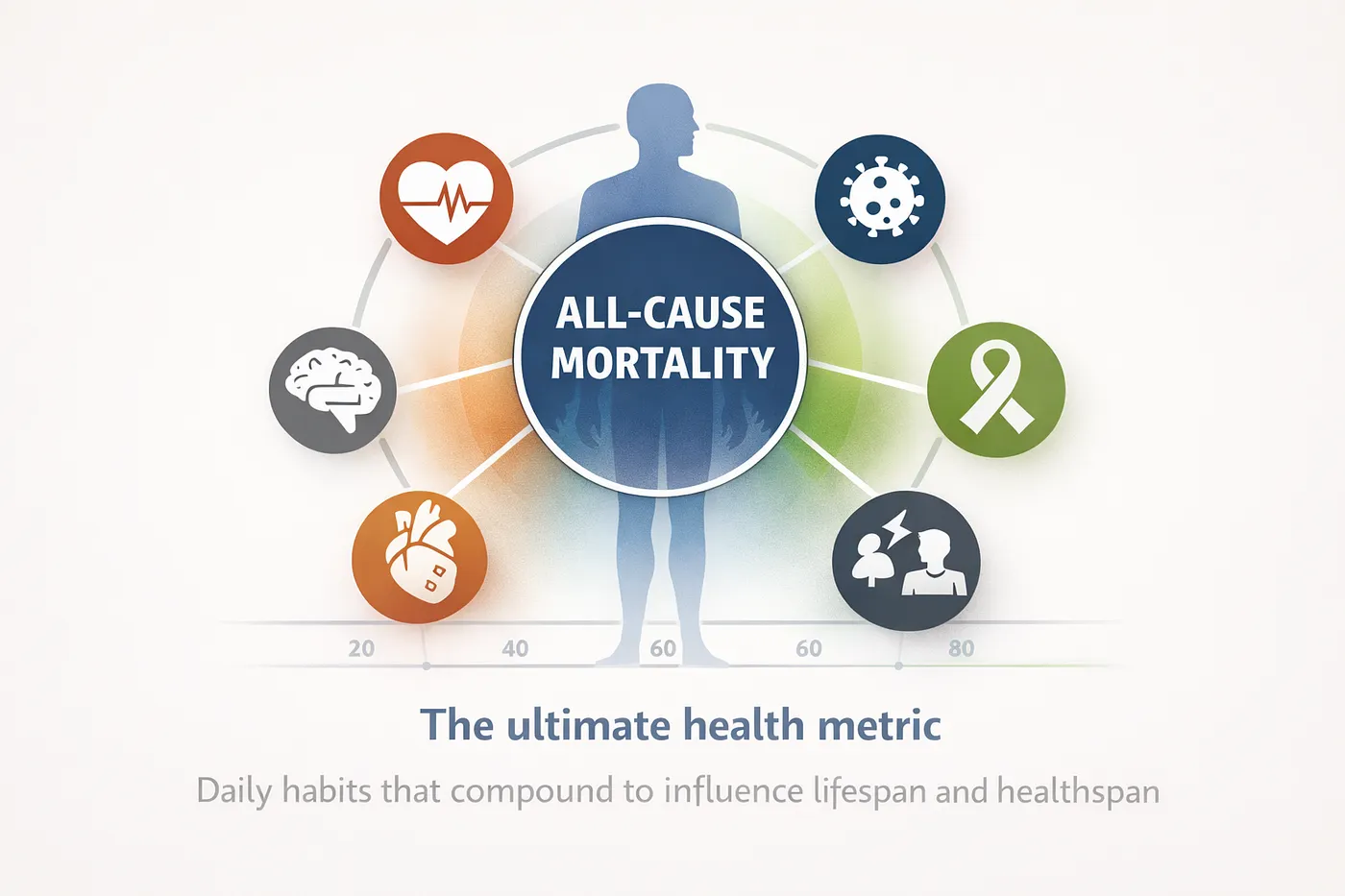
A moment that changed how I look at health
A few years ago, I went down the usual rabbit holes, LDL numbers, VO₂ max, supplements, gadgets, optimization stacks. Everything felt important. Everything felt urgent. And yet, none of it answered the real question I cared about:
“Am I actually reducing my risk of dying early, or just micromanaging numbers?”
That’s when I encountered a deceptively simple concept used by epidemiologists, public-health researchers, and longevity scientists:
All-Cause Mortality.
Once you understand it, you can’t unsee it. It quietly reframes how everything in health fits together.
What Is All-Cause Mortality?
All-cause mortality refers to the risk of death from any cause, rather than from a specific disease like heart disease, cancer, or diabetes.
Instead of asking:
- “Does this reduce heart attacks?”
- “Does this lower cancer risk?”
- “Does this help diabetes?”
It asks a more honest question:
“Do people who do this actually live longer, overall?”
If an intervention lowers one disease risk but raises another, all-cause mortality exposes the truth. There’s nowhere to hide.
Why All-Cause Mortality Is the Gold Standard
In research, all-cause mortality is respected because it:
- Avoids cherry-picking outcomes
- Captures unintended consequences
- Reflects real-world human complexity
A drug, diet, or habit might:
- Improve a lab marker
- Look good short-term
- Even win headlines
But if it doesn’t lower all-cause mortality, it hasn’t proven it helps people live longer.
What Actually Drives All-Cause Mortality
When researchers zoom out, a clear pattern emerges. Most early deaths cluster around a few core drivers.
1. Metabolic Dysfunction
Insulin resistance, visceral fat, fatty liver, and chronic inflammation quietly raise risk across multiple diseases at once.
Key insight: Metabolic health isn’t about weight, it’s about cellular energy balance.
2. Cardiovascular Stress
High blood pressure, poor lipid handling, smoking, and inactivity remain dominant contributors.
Important nuance: Fitness often predicts survival better than body fat percentage.
3. Sleep Deprivation
Chronic sleep debt worsens:
- Hormone regulation
- Blood sugar control
- Immune resilience
- Cognitive judgment
Short sleep doesn’t just make you tired, it shortens life expectancy.
4. Chronic Stress & Isolation
Loneliness and unresolved stress increase mortality risk comparably to smoking in some studies.
Humans are biologically wired for connection, not constant alertness.
5. Muscle Loss (Sarcopenia)
Low muscle mass is a powerful predictor of:
- Falls
- Disability
- Hospitalization
- Early death
Muscle is not cosmetic, it’s metabolic insurance.
Examples That Surprise People
“Healthy” habits that don’t always reduce all-cause mortality
- Extreme calorie restriction without strength training
- Overtraining without recovery
- Chasing low cholesterol at the expense of metabolic health
- Chronic stress in the name of productivity
Boring habits that consistently win
- Walking daily
- Strength training 2–3x/week
- Sleeping 7–8 hours
- Eating mostly whole foods
- Maintaining social bonds
Longevity isn’t flashy. It’s quietly consistent.
Prevention: How to Think Like a Longevity Scientist
All-cause mortality isn’t about predicting when you’ll die.
It’s about answering:
“Is the way I’m living increasing or decreasing my odds, overall?”
You don’t need a perfect formula.
You need directional clarity.
And the good news?
ACM risk is highly modifiable, even later in life.
The behaviors with the strongest evidence:
- Cardiorespiratory fitness — walk, cycle, swim
- Strength & muscle retention — lift, carry, squat
- Sleep protection — consistent timing, darkness, calm
- Metabolic simplicity — fewer ultra-processed foods
- Stress downshifting — breath, nature, presence
- Social resilience — meaningful relationships
These don’t just prevent disease.
They extend usable life.
Healthspan vs Lifespan
All-cause mortality also forces an important distinction:
- Lifespan: How long you live
- Healthspan: How well you live while alive
The goal isn’t merely to delay death, it’s to delay decline.
A longer life without strength, clarity, or independence isn’t a win.
The Eat · Train · Lead Takeaway
Live in a way that reduces your total risk — not just your visible problems.
- Eat to stabilize energy and metabolism
- Train to preserve strength and capacity
- Lead your life with margin, calm, and connection
When you align daily habits with all-cause mortality reduction, longevity becomes a side effect, not an obsession.
All-cause mortality is the metric that makes health optimization honest. It's hard to argue with "does this actually help people live longer?" because the answer cuts through every trend, every supplement claim, and every lab marker that sounds important but doesn't connect to what you actually care about. The good news is that the behaviors with the strongest ACM evidence are boring, accessible, and free: walking, lifting, sleeping, eating real food, and staying connected to people. The unsexy truth is that these matter more than any optimization stack.
Final Thought
If you had to choose one lens to evaluate every health decision, from food to fitness to stress, it wouldn’t be a biomarker or a gadget.
It would be this simple question:
“Does this help people live longer, overall?”
That’s the quiet wisdom of all-cause mortality.
Disclaimer
This article is for educational purposes only and does not substitute for medical advice. Individual health decisions should be made in consultation with qualified healthcare professionals.
Your maintenance calories are the number every goal adjusts around. Get yours in about ten seconds.
Calculate your BMR & TDEE →What I'd Actually Do
- When evaluating any new health intervention (supplement, diet, protocol, device) ask one question first: "Is there evidence this reduces all-cause mortality, or just a single marker?" That filter alone will simplify your stack significantly.
- Prioritize cardiorespiratory fitness above aesthetics. Walk 30 minutes daily at minimum. Fitness predicts ACM more reliably than body fat percentage — that research is consistent across dozens of studies.
- Protect 7–8 hours of sleep harder than any other performance variable. Chronic sleep debt raises all-cause mortality risk independently of almost everything else.
- Add 2–3 strength sessions per week — not for appearance, but for what muscle does metabolically and structurally over decades. Muscle is genuine longevity insurance.
- Audit one chronic stressor this month. Loneliness and unresolved psychological stress carry mortality risk comparable to smoking in some large studies. Connection and downshift matter as much as diet.
- Talk to a clinician if you have metabolic syndrome, cardiovascular disease history, or significant sleep disturbances — these are the highest-leverage conditions to address early for ACM reduction.
About the Author
Raj Chanolian writes about longevity, metabolic health, fitness, and leadership through the lens of Eat · Train · Lead. His work blends science, lived experience, and practical frameworks for sustainable performance — on the mat, in the kitchen, and in life.