The 3 Ds (Threat mode)
I didn’t realize my critical thinking was “offline” until I watched myself behave like someone else.
It was a normal workday. A planning meeting. A roadmap discussion. Nothing dramatic, no yelling, no crisis, no obvious conflict. Just a few stakeholders, a few engineers, a tight timeline, and one slide that had taken me hours to polish.
Halfway through, someone asked a question that should have been easy to handle:
“What analysis did we do to be confident that dependency will land on time?”
That’s it. That was the question.
But my body heard something different.
My chest tightened. My throat went dry. My jaw locked so subtly I didn’t notice it. And my mind, normally calm, analytical, structured, did something strange:
It shrank.
In that moment, I wasn’t thinking in possibilities anymore. I was thinking in positions. I wasn’t exploring. I was protecting.
And within the next five minutes, I cycled through what I now call the 3 Ds, three common threat responses that look “professional” on the outside, but quietly shut down critical thinking on the inside:
1) Defend
I responded fast. Too fast.
I started explaining why the plan was solid instead of examining whether the risk was real.
I wasn’t answering the question. I was defending my competence.
My voice got firmer. My sentences got longer. I reached for certainty like it was oxygen.
2) Dodge
When the conversation moved toward the weakest assumption — one I didn’t have a clean answer for, I pivoted.
I offered a partial answer. I shifted to a different topic. I redirected toward a “safer” part of the plan.
It wasn’t intentional deception. It was a nervous system move:
“Get away from the uncomfortable uncertainty.”
3) Disengage
Then the worst part: I stopped being present.
Not physically, I was still in the meeting.
But mentally, I started going quiet inside. My listening turned shallow. My curiosity disappeared.
I could feel myself trying to end the conversation rather than learn from it. I wanted closure, not clarity.
And that’s when I realized something that hit me like an awkward truth:
My critical thinking wasn’t failing because I wasn’t capable.
It was failing because my brain had switched modes.
In the hallway afterward, I replayed it. The question wasn’t an attack. It was valid. It was actually helpful. If we addressed it early, we’d save weeks later.
So why did I react the way I did?
Because I wasn’t in the thinking state.
I was in the protection state.
That day taught me a framework that has changed how I make decisions, handle adversity, and lead teams through ambiguity:
When the brain senses threat, especially social threat, critical thinking doesn’t gradually decline.
It often flips off like a switch.
And if you don’t learn to notice it, you can spend years believing your best thinking “disappears” under pressure… when really, it’s just being interrupted by a survival pattern.
The 3 Ds: the modern version of fight/flight/freeze (and why they shut down critical thinking)
Most people know the classic survival responses: fight, flight, freeze.
But in modern work and leadership contexts, they rarely show up as dramatic panic. They show up as something quieter and more socially acceptable:
Defend (Fight)
What it looks like:
- talking faster, louder, firmer
- arguing instead of exploring
- trying to “win” the point
- interpreting questions as challenges
What’s really happening:
Your brain is protecting status, competence, identity, or control. The goal shifts from truth to safety.
Critical thinking cost:
- curiosity drops
- assumptions stop being tested
- your brain narrows to one storyline
Counter-switch (back to critical thinking):
- Say: “Let’s slow down and define what we’re trying to learn.”
- Ask: “What would make this not true?”
- Write: assumptions + unknowns in a shared doc/board
Dodge (Flight)
What it looks like:
- avoiding the hard question
- redirecting to what’s comfortable
- delaying decisions
- busywork, side quests, “we’ll circle back”
What’s really happening:
Your brain is escaping uncertainty. It wants relief, not resolution.
Critical thinking cost:
- depth disappears
- you solve smaller problems to avoid the real one
- risk stays hidden until it becomes expensive
Counter-switch:
- Ask: “What’s the smallest step that reduces uncertainty?”
- Time-box: 10 minutes to list unknowns + one test
- Choose a reversible action: “pilot / experiment / prototype”
Disengage (Freeze)
What it looks like:
- going quiet in meetings
- blank mind, low recall
- difficulty choosing
- “whatever you think” energy
- checking out while still “present”
What’s really happening:
Your system is overloaded. It’s not avoidance, it’s shutdown for protection.
Critical thinking cost:
- working memory shrinks
- options collapse
- you can’t access your best reasoning in real time
Counter-switch:
- Regulate body first: longer exhale breathing + ground your posture
- Buy time: “Give me 60 seconds, let me write this out.”
- Move from speaking to writing: it restores cognitive access
Why this matters
Because these responses don’t just affect how you feel.
They determine:
- whether you solve the right problem or the loud one
- whether you explore options or cling to a position
- whether you learn from adversity or repeat it
- whether your team feels safe enough to think with you
And the biggest mistake people make is assuming:
“I’m not good at critical thinking under pressure.”
When the more accurate truth is:
“My brain is flipping into Defend, Dodge, or Disengage, and I haven’t learned the switch back yet.”
The 3 Cs (Thinking mode)
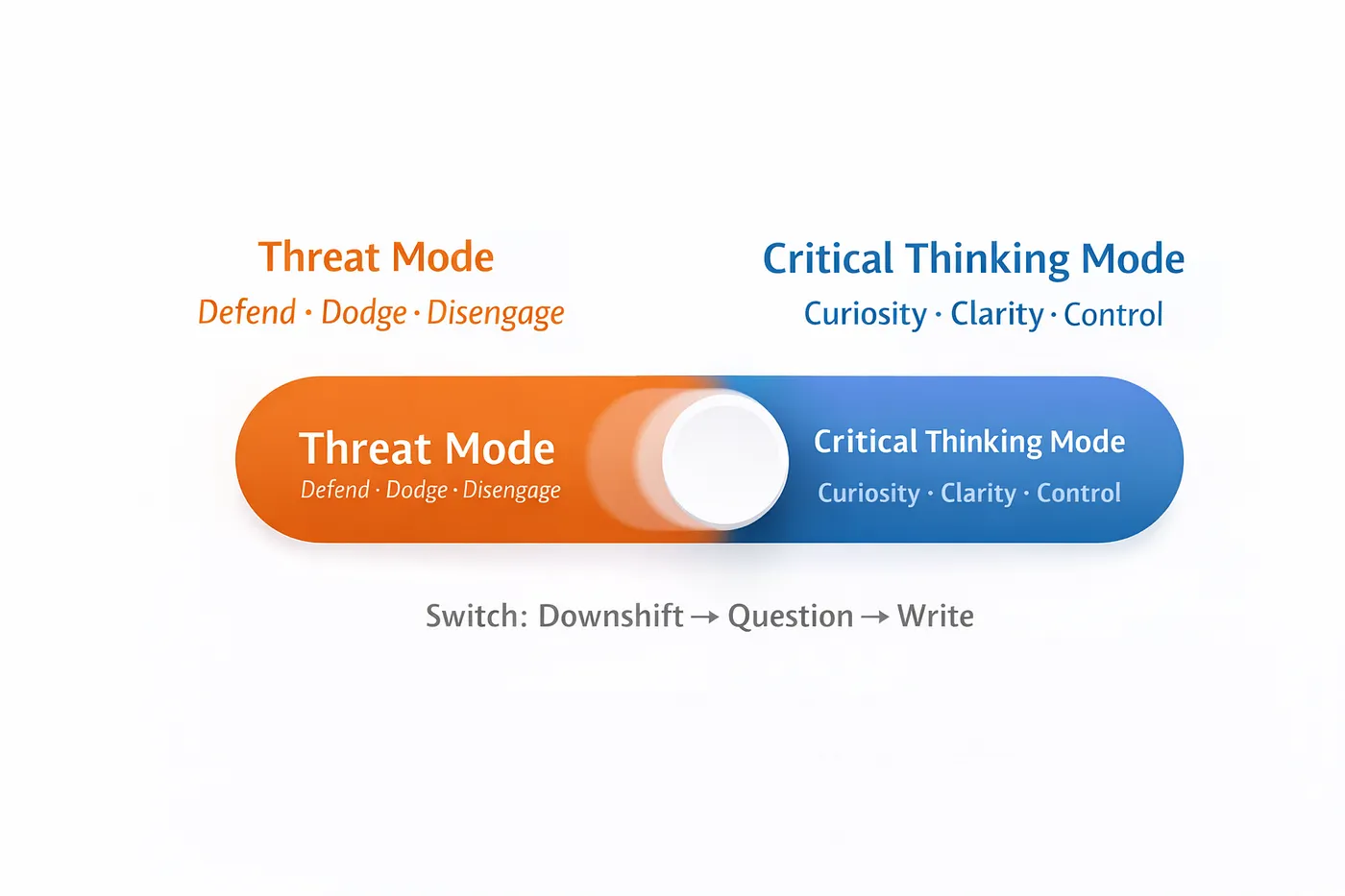
If one side of the brain illustration is the 3 Ds (Threat / Protection Mode), the “other side” (Critical Thinking / Executive Mode) can be a matching cluster of responses + skills that come online together.
Curiosity
- Ask “What am I missing?”
- Consider 2–3 explanations
- Seek disconfirming evidence
Clarity
- Define the real decision
- Separate facts vs. stories
- Name assumptions + unknowns
Control
- Pause before reacting
- Regulate breath/body
- Choose the next best step
How to switch critical thinking back on (on demand)
The most important reframe is this:
You can’t “think” your way back into critical thinking if your nervous system still thinks you’re under threat.
So the switch has two parts:
- Regulate the state (body + attention)
- Rebuild the thinking workspace (curiosity + structure)
There’s a protocol I use now, simple enough to do in the middle of a meeting, powerful enough to change outcomes.
The 90-Second Switch Protocol
Use it the moment you notice Defend, Dodge, or Disengage.
1) Name the mode (5 seconds)
Silently label it: “Defend” or “Dodge” or “Disengage.”
This creates distance between you and the reaction.
2) Downshift the body (30–60 seconds)
Pick one:
- Long exhale breathing: inhale 4, exhale 6 (5 cycles)
- Jaw + shoulders release: relax your face and drop your shoulders
- Widen your vision: stop staring; look at the whole room
Why this works: you’re signaling “not immediate danger,” which is what lets higher cognition come back online.
3) Flip concern into curiosity (10 seconds)
Ask one of these (out loud if you can):
- “What else could be true here?”
- “What would change our mind?”
- “What are we assuming that we haven’t said?”
Curiosity is not fluff. It’s a different operating mode.
4) Externalize the thinking (60 seconds)
Open a doc / whiteboard and write:
- Decision: what are we deciding?
- Assumptions: what must be true?
- Unknowns: what do we need to learn?
Your brain can’t hold complexity indefinitely. Writing becomes your working memory.
Result: your critical thinking doesn’t magically return. It becomes possible again.
The critical thinking workspace: how to rebuild it
Even after you regulate, critical thinking needs a structure, especially for sophisticated problems where there isn’t a single “correct” answer.
The CLARITY Decision Format (fast and team-friendly)
Use this in meetings, docs, or your own notes:
- Clarify the decision (one sentence)
- List assumptions (what must be true)
- Ask what you don’t know (unknowns)
- Review 3 options (including do nothing)
- Identify tradeoffs (cost, time, risk, reversibility)
- Test with a smallest experiment (what reduces uncertainty fastest?)
- Yield a decision + revisit signal (what would make us change course?)
This prevents the #1 trap under pressure: solving the loudest problem instead of the real one.
How non-critical thinking quietly damages outcomes
The 3 Ds don’t just make you feel stressed. They create predictable organizational mistakes:
Defend leads to…
- teams protecting positions instead of testing assumptions
- politics disguised as certainty
- slower learning because dissent becomes “dangerous”
Dodge leads to…
- “busy but stuck” execution
- risk surfacing late (when it’s expensive)
- chronic revisiting of the same unresolved issues
Disengage leads to…
- groupthink (because quieter minds disappear)
- decisions made by the loudest voice
- loss of creativity, because creativity requires safety
And the biggest hidden cost:
You stop noticing opportunities, because opportunities look like uncertainty first.
Critical thinking is how you keep your mind open long enough to spot them.
How to lead a team out of the 3 Ds (and into higher thinking)
Here’s the leadership reality:
Your team borrows your nervous system.
If you signal threat (impatience, sarcasm, certainty-as-status), your team will either Defend, Dodge, or Disengage, even if they don’t say it out loud.
Your job is to make critical thinking safe in public.
1) Set the tone with “cognitive safety” language
Use phrases that lower threat and increase exploration:
- “Let’s separate confidence from evidence.”
- “I might be missing something. What am I not seeing?”
- “Questions are contributions here.”
- “Let’s slow down. We’re getting narrow.”
2) Make dissent a role, not a personality
Rotate roles in important discussions:
- Challenger: finds disconfirming evidence
- Framer: restates the problem in 2–3 ways
- Signal owner: defines what would prove the decision wrong
This removes ego from disagreement.
3) Run a 10-minute pre-mortem (high ROI)
Ask:
“It’s 90 days later. This failed. Why?”
This invites truth without labeling anyone negative.
4) Reward updates, not just answers
When someone changes their mind based on evidence, highlight it:
- “That was a strong update.”
- “Good catch. This saves us later.”
- “That question improved our decision quality.”
You’re training the group to value learning over looking right.
5) Use a decision log (tiny habit, massive clarity)
Record:
- decision
- assumptions
- owner
- revisit signal/date
This shifts the culture from “opinions in meetings” to “learning over time.”
A practical “in-the-room” playbook (what to do live)
If you feel yourself Defending
Say:
- “Let me pause. I’m getting protective. I want to understand the concern.”
Then ask:
- “What would change our minds?”
If the team is Dodging
Say:
- “We keep circling. What’s the uncertainty we’re avoiding?”
Then ask:
- “What’s the smallest test that reduces it?”
If someone is Disengaging
Say:
- “I want to hear your thinking. Take 60 seconds, write it first.”
Then wait. Silence is a leadership tool.
ETL Takeaways
E — Eat (stability): stable energy + hydration + sleep protect the brain’s bandwidth.
T — Train (reflex): practice the 90-second switch + the curiosity prompts until it becomes automatic.
L — Lead (culture): make truth-telling safe, rotate dissent roles, and reward people for updating based on evidence.
Closing: the real skill is switching, not perfection
The goal isn’t to never enter Defend, Dodge, or Disengage.
You will. Everyone does.
The goal is to notice it sooner and return faster.
Because the difference between average outcomes and extraordinary ones is often not intelligence — it’s this:
Can you stay curious when your brain wants certainty?
Can you stay open when your nervous system wants safety?
Can you keep critical thinking online when adversity shows up?
That’s the upgrade.
And once you learn it, you don’t just become a better problem solver.
You become someone other people trust — because you don’t just react to reality.
You think with it.
The 3 Ds aren't a character flaw — they're a nervous system response, and once you understand that, you stop being surprised when you or your team hits them. The 90-second switch protocol is simple enough to use in an actual meeting, which is the only kind of protocol worth having. The harder part is building the habit of noticing the mode you're in before you've already spent 10 minutes defending a position you don't actually believe in. That awareness is the real upgrade.
Disclaimer
This article is for informational and educational purposes only. It’s a practical framework, not professional psychological or medical advice.
About the Author
Raj Chanolian is a technology leader in a fast-growing organization. His work sits at the intersection of reliability, security, modernization, and operational excellence, helping teams build platforms that can scale without breaking trust. Raj is passionate about coaching and collaboration as leadership multipliers, and he brings a practical “systems mindset” to people and process: how we think, decide, communicate, and respond under pressure. He writes to translate complex engineering and health concepts into simple, usable tools for leaders and builders.
What I'd Actually Do
- This week, in one meeting where you feel friction, silently label whether you're in Defend, Dodge, or Disengage. Just the label — nothing else. That step alone will change your next sentence.
- Memorize one curiosity question and use it as your default when you feel defensive: “What am I not seeing here?” It's disarming, it works, and it reads as leadership rather than retreat.
- Run the CLARITY format on the next complex decision your team is circling. Write it in a shared doc mid-meeting. Externalizing decision, assumptions, and unknowns reduces ego from the room immediately.
- Try the 90-second body regulation step before your next high-stakes conversation: 4-count inhale, 6-count exhale, five cycles. You're not performing calm — you're creating it physiologically.
- Run one pre-mortem this month on a current project. Ask: “It's 90 days from now and this failed — why?” The answers will surface what people are actually worried about but not saying in the room.