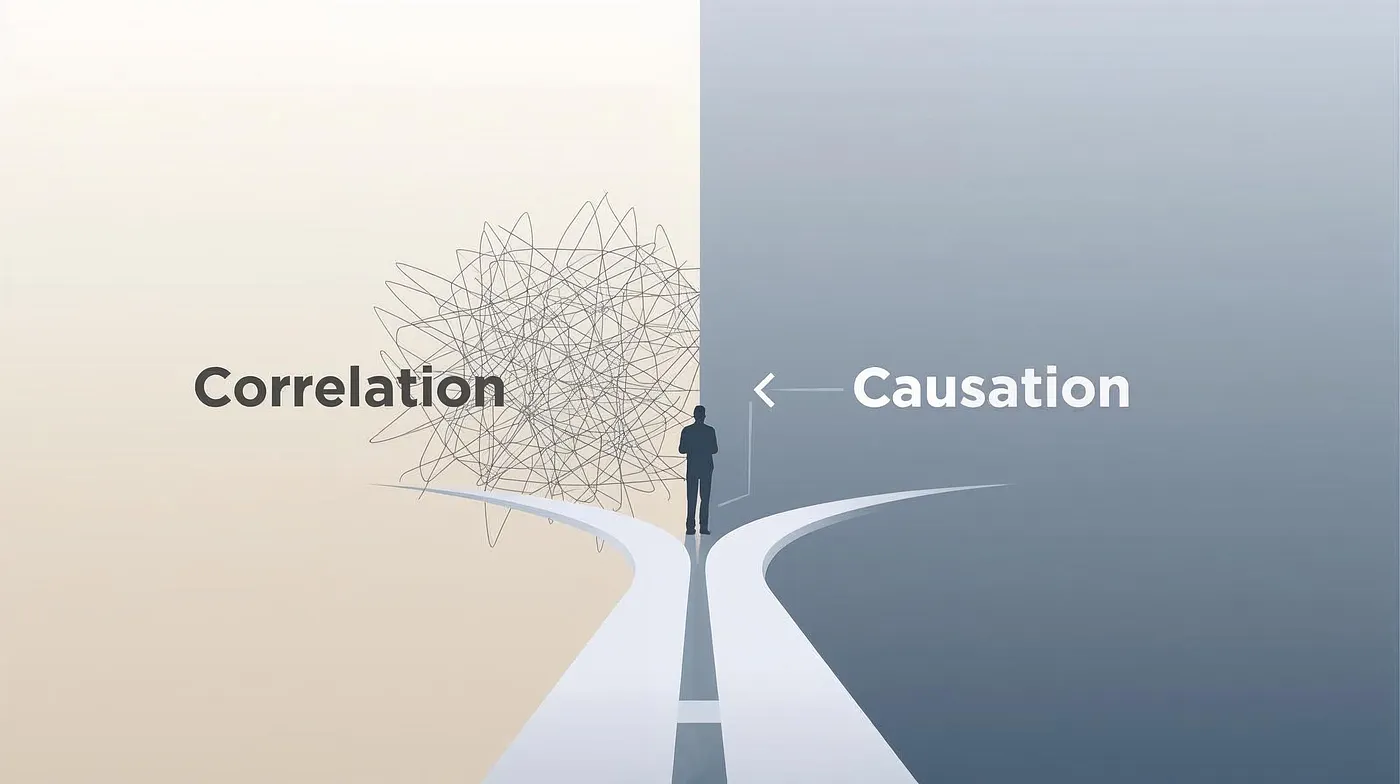
The Mental Model We Wish We Learned Earlier
Most of life’s costly mistakes happen not because people lack intelligence, but because they mistake correlation for causation.
- Correlation = Two things happen together.
- Causation = One thing truly drives the other.
Almost everything looks connected if you stare long enough. Only a few things are.
Understanding the difference is a superpower. Misunderstanding it is a trap.
This skill becomes even more critical in two places where you operate daily:
- Your health and fitness, where decisions impact your longevity.
- Your work where decisions impact systems, teams, and customers.
Let’s break it down with simple lessons, practical applications, and real personal stories.
SECTION 1: CORRELATION VS. CAUSATION
Correlation
Two things appear linked, but neither is necessarily causing the other.
Example:
Ice cream sales and drowning deaths both rise in summer. But ice cream doesn’t cause drowning.
“High LDL causes heart attacks.”
Not necessarily.
It’s like saying:
“Firemen cause fires because they are always present at fires.”
Firemen correlate with fires. They don’t cause them.
Similarly, LDL often shows up where damage already exists, but isn’t always the driving cause.
Causation
One event actually produces the other.
Example:
Eating in a caloric surplus over time causes weight gain.
Why We Confuse the Two
- Humans love patterns (even imaginary ones).
- We want fast explanations.
- Data can mislead without context.
- Our emotions bias us into believing “X happened after Y, so Y caused it.”
This shows up everywhere, in health, fitness, team dynamics, incidents, and even daily decisions.
SECTION 2: HEALTH & FITNESS: WHEN CORRELATION MISLEADS YOU
Health decisions often get skewed because symptoms and habits appear connected. But many correlations are coincidences or partial truths.
Here are places where people typically get fooled:
1. “My cholesterol went up after eating eggs.”
Reality: Eating eggs correlates with higher cholesterol in some observations but rarely causes it.
Other culprits may include:
○ Poor sleep
○ High stress
○ Excess refined carbs
○ Genetic LDL patterns
○ Weight gain
Debugging technique:
Ask: What changed in the last 4 — 6 weeks besides eggs?
Often, the true cause is lifestyle, not the single food we blame.
2. “I gained weight because of this one food.”
People often blame:
○ Rice
○ Bananas
○ Bread
○ Roti
But single foods rarely cause weight gain. Total caloric behavior, sleep, hydration, and hormonal patterns usually do.
Debugging causation:
» Track patterns for 2 — 3 weeks
» Remove one variable, not five
» Reintroduce it to verify impact
3. “My new supplement boosted my energy.”
Or did:
- Your sleep improves unintentionally?
- You reduce caffeine?
- Your diet cleaned up because you “felt motivated”?
This is correlation dressed as causation.
The Day I Blamed My Pre-Workout for Something It Didn’t Do
Years ago, I switched to a new pre-workout and felt unusually strong during that week. I concluded, “This pre-workout is amazing!”
But later I realized:
I had slept 8 hours each night that week, something I rarely did.
Causation = Sleep
Correlation = Pre-workout timing
That moment taught me the golden rule:
Never reward the wrong variable.
4. “My wearable data shows my stress is high, so my job must be the cause.”
Wearables measure correlated metrics, not root causes.
Your stress score may reflect:
○ Poor hydration
○ Blood glucose fluctuations
○ Overtraining
○ Alcohol the night before
○ Inflammation
○ Even sensor placement
Correlation ≠ causation.
Wearables give clues, not conclusions.
SECTION 3: ENGINEERING & LEADERSHIP: WHERE CORRELATION CAN BREAK TEAMS
Never confuse proximity with responsibility.
Leadership is full of misleading correlations:
1. “Deployments increased this quarter, so incidents must be caused by deployments.”
Not necessarily.
Possible underlying causes:
○ Missing automated tests
○ Architectural risks
○ Legacy dependencies
○ Skills gap
○ Lack of observability
Debugging this requires:
» 5 Whys
» Time-series cross-checks
» Event log correlation
» Eliminating confounders
2. “Team morale dropped after we introduced a new tool.”
Maybe.
Or maybe:
○ Workload increased
○ Deadlines tightened
○ Recognition dropped
○ Hiring was frozen
○ Personal stress outside work
Tools are convenient to blame because they’re visible.
Real causes are usually systemic and slower.
3. “Customer churn rose after we launched Feature X.”
Correlation. Not conclusion.
Churn might be caused by:
○ Competitor pricing
○ Seasonality
○ Economic downturn
○ A bug in a different part of the system
Debugging method:
» Link every churn event with independent variables
» Look for consistent patterns
» Separate noise from signal
The Incident We Blamed on the Wrong Team
Years ago, a latency spike occurred right after a configuration push by Team A.
Everyone pointed fingers:
“The push caused the incident.”
After full RCA:
The real cause: A downstream vendor API slowed down due to their own maintenance.
Team A’s push simply happened around the same time. If we had punished the wrong team, morale would have taken a hit.
This cemented an engineering truth for me:
- Never confuse proximity with responsibility.
SECTION 4: HOW TO DEBUG: A PRACTICAL FRAMEWORK
Here is a simple checklist you can use in health, fitness, engineering, and leadership.
Step 1: (Ask) What else changed?
Most false conclusions fail this test.
Step 2: Test one variable at a time
Do not remove five foods.
Do not change three processes.
Do not revamp the whole team process at once.
Step 3: Look for repeated patterns
One event ≠ proof
Three events ≠ proof
Ten events in consistent alignment ≠ coincidence
Step 4: Eliminate confounding factors
These are hidden variables that secretly cause everything.
Example:
You think your LDL rose because of diet.
Actual cause = poor sleep for 30 days.
Step 5: (Ask) Does the mechanism make sense?
Causation requires a biological, logical, or technical mechanism.
Example:
Feature A cannot cause latency if it never touches that code path.
Step 6: Run the reverse test
If removing the variable solves it → more likely causation.
If nothing changes → correlation.
SECTION 5: WHEN NOT TO APPLY CAUSATION LOGIC
Some decisions do not require deep causal proof.
Examples:
- Drinking more water
- Sleeping 7 — 8 hours
- Strength training
- Walking daily
- Praising your team
- Reducing sugar
- Adding monitoring and logging
These are universally beneficial. You don’t need causation studies to justify them.
SECTION 6: THE ULTIMATE TAKEAWAY
Bad decisions come from blaming the wrong cause.
Great decisions come from questioning the obvious one.
Your health improves when you track patterns with clarity.
Your fitness improves when you understand what truly works for your body.
Your leadership improves when you stop reacting to correlations and start investigating root causes.
Correlation can guide you. Causation can transform you.
This mental model won't make you popular when you use it to question popular explanations — but it will make you right more often. The discipline of asking "what else changed?" before drawing conclusions is genuinely rare in health conversations, engineering postmortems, and leadership decisions. Apply it once per week deliberately and it becomes automatic within a month.
Eat · Train · Lead Takeaways
Understanding correlation vs. causation isn’t just a data concept. It’s a lifestyle discipline. When applied consistently, it becomes a powerful filter across how you eat, how you train, and how you lead.
EAT: Make Smarter Health & Nutrition Choices
Most diet confusion comes from blaming the wrong cause.
- One food rarely makes you unhealthy.
- One supplement rarely transforms your energy.
- One week of eating differently rarely changes your biomarkers meaningfully.
ETL takeaway:
» Don’t punish the wrong food or reward the wrong habit.
» Track, test, and understand what’s actually driving changes in your body.
When you stop reacting to correlations, you start building a sustainable, intelligent lifestyle.
TRAIN: Improve Performance Through True Causes, Not Assumptions
Training decisions often get clouded by coincidence:
“My strength jumped this week because of a new pre-workout.”
“My weight loss stalled because of carbs.”
But performance is shaped by sleep, stress, recovery, calories, and progressive overload, not by one magical variable.
ETL takeaway:
» Test one variable at a time.
» Look for repeated patterns.
» Build training programs based on causes you can control, not correlations that mislead you.
When you understand causation, your workouts stop guessing, and start progressing.
LEAD: Make Better Engineering & Leadership Decisions
Great leaders don’t react to noise.
They investigate signals.
They never confuse proximity with responsibility.
Just as firemen don’t cause fires, deployments don’t always cause incidents.
Just as LDL shows up at the site of inflammation, team sentiment may shift because of deeper systemic causes.
ETL takeaway:
» Debug the system, not the symptom.
» Never blame the visible variable without checking the hidden ones.
» Ask: “What else changed?” before reacting.
What I'd Actually Do
- When something improves or gets worse this week, ask: "What else changed in the last 4–6 weeks?" before crediting or blaming the obvious thing.
- Change one variable at a time — in your diet, training, or engineering environment. This is harder than it sounds and more valuable than any optimization tool.
- In post-incident reviews, run the reverse test: if we hadn't deployed, would the incident still have happened? Proximity to an event isn't responsibility for it.
- When your wearable shows elevated stress, check hydration, sleep, and caffeine before concluding your job is the cause. Start with physiology, not narrative.
- The next time a supplement, food, or training change "works," wait three more weeks and look for the confounding variables. Earn the attribution before crediting it.
Leadership becomes clearer, calmer, and more credible when you stop chasing correlations and start discovering true causes.
Disclaimer
This article is for educational and informational purposes only. It is not medical advice, diagnostic guidance, or a substitute for professional healthcare or engineering consultation. Always consult qualified medical professionals for health-related decisions, and follow your organization’s engineering, security, and incident-management protocols for technical decisions. The personal stories and examples shared here are illustrative and not prescriptive.
About the Author
Raj Chanolian is a Platform Engineering Leader, fitness enthusiast, and the creator of the Eat · Train · Lead philosophy, a lifestyle framework that blends health, performance, and leadership clarity. With decades of experience building resilient, scalable systems and coaching teams through growth and transformation, Raj brings a unique perspective that connects engineering principles with everyday human behavior.
His writing explores mental models, decision-making, fitness fundamentals, resilience, and the personal practices that help high-performing professionals thrive both at work and in life.
When he’s not architecting platforms or analyzing fitness data, Raj enjoys experimenting in the kitchen, exploring new wellness approaches, and inspiring others to build stronger bodies, sharper minds, and more intentional careers.