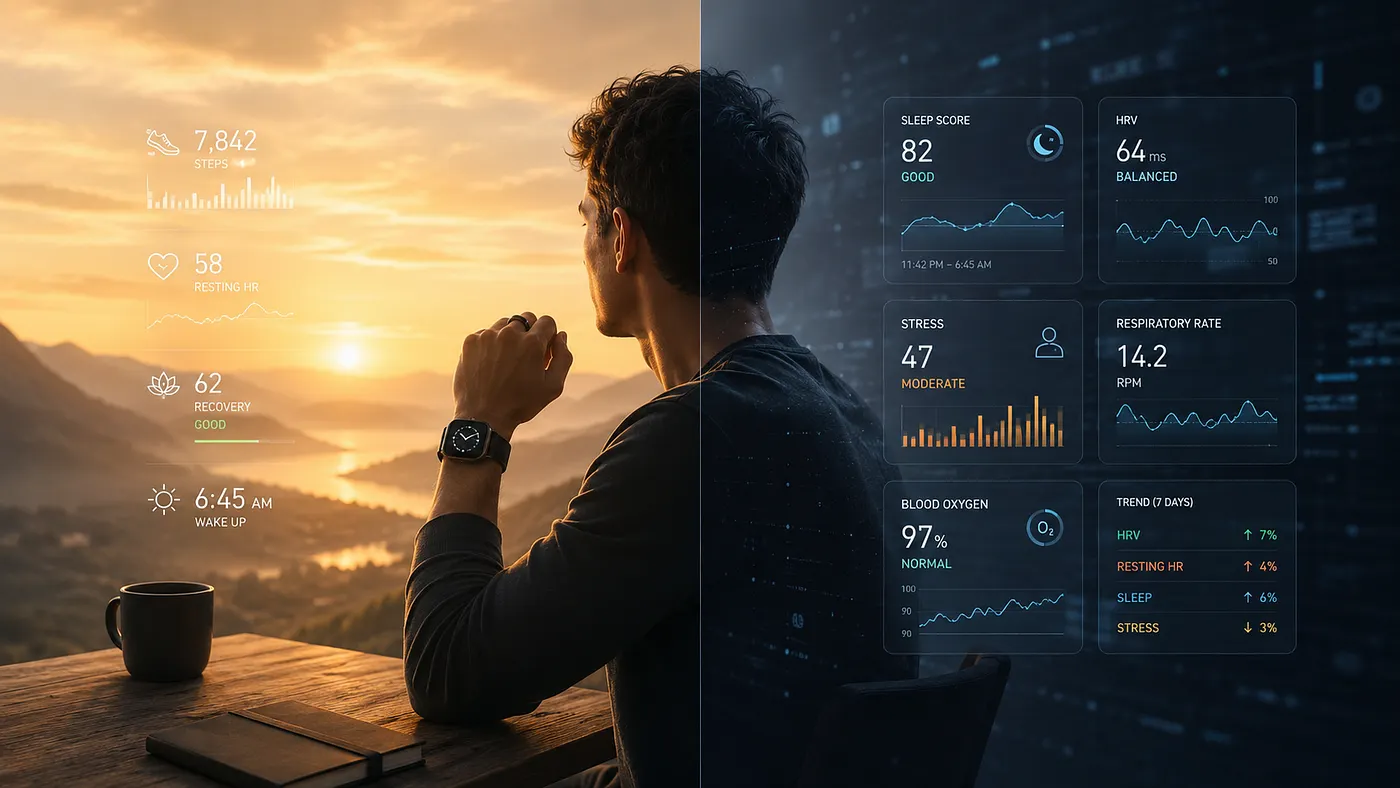
The Beginning Is Innocent
It always starts simple.
You wear a device like the Apple Watch or the Oura Ring or UltraHuman Ring or the Withings ScanWatch 2 and think:
“Let me just count my steps.”
10,000 becomes the goal.
Then 12,000.
Then “Why did I only hit 8,200 today?”
And before you realize it, your day isn’t just lived, it’s measured.
- Steps
- Heart rate
- HRV (Heart Rate Variability)
- Sleep score
- Recovery score
- Stress rhythm
- Calories
- Blood oxygen
Your body becomes a dashboard.
The question is no longer “How do I feel?”
It becomes “What do the numbers say?”
So… was that a good thing?
The answer is nuanced.
The Upside: When Data Becomes Power
There’s a strange moment that happens after a few weeks of wearing a health tracker. You stop seeing your body as random and start seeing it as a system with patterns. Suddenly, poor sleep isn’t “just a bad night.” It has fingerprints. Stress leaves clues. Recovery becomes measurable. Even your late-night snack starts appearing in your morning readiness score like a silent confession. For the first time, many people realize their body has been talking to them all along… the wearable simply gave it subtitles.
1. Awareness → The First Real Upgrade
Most people live disconnected from their bodies.
Wearables close that gap.
You start noticing patterns:
- Poor sleep → worse mood
- Late meals → lower HRV
- Alcohol → wrecked recovery
- Exercise → improved resting heart rate
This is powerful.
Because what gets measured… gets managed.
2. Behavioral Change Through Feedback Loops
Your devices create micro-feedback loops:
- “You slept 5h 12m” → go to bed earlier
- “Low HRV today” → skip intense workout
- “High resting heart rate” → reduce stress load
This is essentially real-time coaching without a coach.
Over time, these loops compound into:
- Better sleep hygiene
- Consistent movement
- Smarter recovery
3. Early Warning System
Your body whispers before it screams.
Wearables amplify those whispers:
- Elevated resting heart rate → possible illness
- HRV drop → stress overload
- Sleep disruption → hormonal imbalance
Many users report detecting:
- Oncoming sickness
- Overtraining
- Burnout patterns
Before they feel it.
4. Objective Truth vs Subjective Bias
We are notoriously bad at self-assessment.
You might say:
“I slept fine.”
Your data might say:
“You woke up 9 times.”
This objectivity helps cut through:
- Denial
- Optimism bias
- Emotional misjudgment
5. Gamification = Consistency
Let’s be honest.
Closing rings… feels good.
Streaks, scores, goals, they turn health into a game.
And games drive:
- Consistency
- Motivation
- Engagement
For many, this is the difference between:
Knowing what to do… and actually doing it.
The Downside: When Data Becomes Dependency
At first, the numbers feel empowering. But slowly, something subtle begins to change. You wake up and check your recovery score before checking how you actually feel. A “bad” sleep score can ruin a perfectly good morning. A low HRV reading suddenly makes you question your workout, your stress, even your health. Without realizing it, the device shifts from being a tool you consult… to a voice you obey. And that’s the dangerous line where self-awareness can quietly become self-surveillance.
1. Data Overload → Decision Fatigue
At some point, you stop tracking data…
…and data starts tracking you.
Too many metrics create:
- Confusion
- Contradictions
- Mental fatigue
Example:
- HRV says “rest”
- Step goal says “move”
- Calorie goal says “burn more”
Now what?
2. The Rise of Health Anxiety (Orthosomnia)
There’s a growing phenomenon called:
Orthosomnia is the growing obsession with achieving “perfect” sleep scores and metrics, where the pursuit of ideal sleep data ironically creates more stress and anxiety around sleep itself.
You start chasing:
- Sleep scores
- HRV numbers
- Recovery ratings
Ironically, this increases stress, which worsens the very metrics you’re trying to optimize.
You go from:
“Did I sleep well?”
To:
“Why is my sleep score only 82?”
3. Losing Internal Awareness
This is the biggest hidden cost.
You outsource your intuition.
Instead of:
- Listening to your body
- Feeling your energy
- Sensing your limits
You wait for permission from a device.
Over time, this weakens:
- Interoception (internal body awareness)
- Self-trust
4. False Precision
Your devices are good…
…but not perfect.
They estimate:
- Calories
- Sleep stages
- Stress levels
Sometimes inaccurately.
But the numbers feel precise:
“Your recovery is 73%”
That level of specificity can be misleading.
It creates illusion of control.
5. Psychological Pressure
Metrics can quietly become expectations.
- “I must hit 10,000 steps”
- “My HRV must improve”
- “I need a 90+ sleep score”
Health becomes:
- A performance review
Instead of:
- A lived experience
The Turning Point: From Tracking → Understanding
The real evolution isn’t:
More data
It’s:
Better interpretation
Here’s the shift that changes everything, Phase and Mindset:
- Beginner -> “Track everything”
- Intermediate -> “Optimize everything”
- Advanced -> “Trust patterns, not numbers”
A Smarter Way to Use Wearables
The healthiest relationship with wearable technology isn’t built on constant monitoring, it’s built on learning when the data is helping you become more aware… and when it’s quietly taking away your peace.
1. Pick 3–4 Core Metrics Only
Focus on:
- Sleep duration
- Resting heart rate
- HRV trends (not daily spikes)
- Daily movement
Ignore the rest unless needed.
2. Think in Trends, Not Days
One bad night ≠ problem
One low HRV ≠ burnout
Look for:
7–14-day patterns
3. Use Data as a Mirror, not a Master
Ask:
“Does this match how I feel?”
Not:
“What should I feel based on this?”
4. Schedule “Untracked Days”
Yes, this matters.
Take 1–2 days/week where:
- You don’t check metrics
- You move intuitively
- You sleep without scoring
This rebuilds:
- Internal awareness
5. Build a Personal Operating System
Instead of chasing generic scores, define:
- What does your good day feel like?
- What patterns improve your energy?
Your device should support that, not define it.
Wearables are genuinely useful — but only up to a point. The data reveals patterns your subjective perception would miss, especially around sleep and recovery. Where it breaks down is when the score starts running your mood instead of informing it. Use the trends, ignore the daily noise, and schedule at least one day a week where you don't check anything.
The Real Answer: Was It a Good Thing?
Yes… and no.
Tracking everything is powerful —
but only when it leads to clarity, not control.
The goal isn’t to become a machine that hits metrics.
The goal is to become:
A human who understands their body deeply.
ETL Takeaway (Eat · Train · Lead)
- Eat: Use data to understand how food impacts you, but don’t reduce meals to numbers.
- Train: Let metrics guide intensity but listen when your body disagrees.
- Lead: The best leaders don’t outsource judgment, to dashboards or devices.
Final Thought
At first, you wear the device.
Then the device shapes your behavior.
The real mastery?
Using the data… without becoming it.
Disclaimer
This article is intended for educational and informational purposes only and reflects personal experiences and general wellness insights. Wearable devices and biometric data are not medical diagnostics and should not replace professional medical advice, diagnosis, or treatment. Always consult a qualified healthcare professional regarding concerns about your health, sleep, stress, or fitness.
What I'd Actually Do
- Pick 3–4 metrics max — sleep duration, resting heart rate, HRV trend, and daily steps. Everything else is noise until those are stable.
- Look at 7–14 day rolling trends only. A single bad night or low HRV score tells you almost nothing actionable.
- Take 1–2 days a week completely untracked — move intuitively, sleep without checking a score. It rebuilds internal body awareness that devices quietly erode.
- When the number contradicts how you feel, trust how you feel. Use data as a prompt for questions, not a final verdict.
- If tracking is making you more anxious or worse at sleeping, that's the data telling you something — take a break from the device entirely.