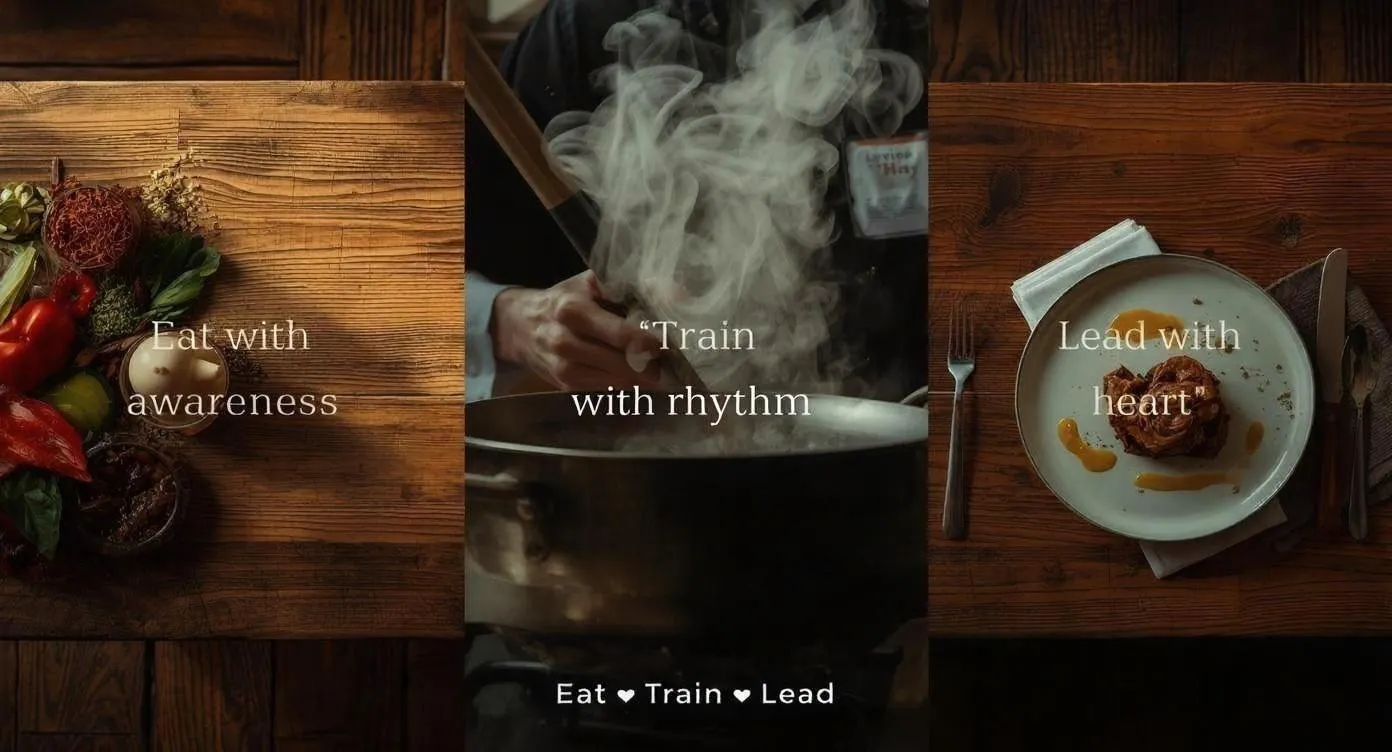
How It All Began — From Survival to Curiosity
I never planned to fall in love with cooking.
For most of my life, it was an occasional experiment, a Sunday omelet, a rushed curry, a rare attempt to prove I could fend for myself. My culinary skills were limited, my confidence even more so.
Then came 2020. The pandemic changed everything, routines collapsed, restaurants shut, and suddenly, the kitchen wasn’t optional anymore. It became the one room where life still moved, one meal at a time.
At first, I stumbled. My spices were mismatched, my timing off, and every recipe felt like an unsolved puzzle. But somewhere between those imperfect meals, something shifted.
What began as a daily necessity turned into an unexpected classroom.
It usually starts on a quiet Saturday morning. My wife’s still asleep, my dog is curled in her corner, and the kitchen counter gleams like a blank canvas. I cue some soft jazz, lay out the ingredients, and take a long breath before the first cut.
The world slows down.
This small ritual has been my sanctuary, the place where I practice the same principles that shape my work, my fitness, and my leadership. Cooking stopped being about recipes long ago. It became a reflection of everything I believe in systems, timing, structure, patience, and love.
It’s the same framework I use to lead teams, design resilient platforms, and even train at the gym, just more aromatic.
That’s where Eat · Train · Lead begins , with awareness in the simplest act of nourishment.
Precision: The Engineering of Flavor
In Platform Engineering, precision saves systems. In cooking, it saves flavors.
The best meals, like the best architectures are born from structure.
Every time I prep ingredients, I think of Mise en place, the French phrase meaning everything in its place. It’s the culinary version of a deployment checklist.
You don’t start chopping onions after the oil is already hot.
You plan. You stage. You align every element so that the moment heat meets spice, the system flows without chaos.
When we are building infrastructure, it’s the same.
You don’t start scaling before observability. You don’t rush to modernize before you understand the recipe, your dependencies, your tools, your flavor profiles.
There’s one day I’ll never forget. I was trying to perfect a new version of my keto butter chicken. Everything looked flawless: the color, the aroma, the texture. Then I tasted it; too salty. Not just a little off but ruined.
I had rushed. I had skipped tasting mid-process.
That moment stuck with me. It wasn’t a cooking failure. It was a systems failure. In Platform Engineering, I’ve seen the same thing happen. You skip validation. You assume your “inputs” are right. And then the whole deployment tastes like regret.
Since that day, my motto both in the kitchen and in the cloud became:
Always Measure, taste, and verify.
Mise en place now isn’t just a French phrase for cooking prep. It’s my daily discipline, whether I’m staging ingredients or staging code. Everything has its place before the heat turns on.
Consistency in cooking, like uptime in engineering, is not achieved through creativity. It’s achieved through preparation.
There’s a strange calm in weighing out 200 grams of chicken or measuring 15 ml of olive oil. It’s not obsessive, it’s respect for precision.
The same respect I give to a production database or a 5:30 a.m. deadlift session.
Patience: The Hidden Ingredient
Cooking teaches you humility faster than any leadership workshop.
Years ago, I used to overtrain in the gym, over-optimize systems, over-schedule my team, and burn out every time.
Cooking changed that.
One evening, I was in a hurry to finish dinner before a late-night call. The recipe said “caramelize onions for 15 minutes.” I cranked up the flame, hoping to cut the time in half.
Ten minutes later, the onions were black. Dinner, and my mood were both burnt.
That small act of impatience taught me something profound “you can’t rush flavor, just like you can’t rush growth”.
Now, when I sauté, I listen to the rhythm of the pan. I’ve learned to wait for the exact shade of gold, the perfect aroma that signals readiness. That waiting rewired me.
Patience in cooking became patience in leadership.
Not everything needs more heat. Sometimes it just needs time.
It’s funny, the same principle that applies to risotto applies to teams.
Stir too often, and you disrupt the process.
Neglect it, and it sticks.
But stay engaged, observant, and gentle, and magic happens.
When I started leading larger teams, I carried that memory with me.
I stopped trying to “fix” people or “accelerate” results. I started simmering instead, giving space, time, and gentle heat until the best parts of people surfaced naturally.
Now, when things move slower than I’d like, I think of those onions.
And I wait.
Passion: The Art Beyond the Recipe
Somewhere along the way, I stopped cooking just to eat. I started cooking to create.
It wasn’t about following recipes anymore. It was about crafting experiences. I realized that a perfectly balanced meal is not just a product of taste but of emotion, care, and flow.
That’s when it hit me. This is leadership.
Good leaders don’t just deliver outputs.
They deliver experiences, a sense of trust, flavor, and craftsmanship that lingers.
One Sunday, a few friends came over. I decided to make a simple meal “Keto Butter Chicken with grilled cauliflower and a drizzle of ghee”. Nothing extravagant, but every detail mattered, the orange hue of the gravy, the swirl of cream that had to look just right, the hint of Coriander Leaves scattered like confetti.
As I plated it, I caught myself adjusting the drizzle, aligning the garnish, warming the bowl so the sauce would shine.
Someone laughed and said, “Raj, you’re plating curry like a Michelin chef.”
They weren’t wrong. I wasn’t just cooking; I was crafting an experience.
That’s when it hit me this isn’t just cooking; it’s care.
Just like I obsess over uptime, deployment flow, and design, I care about how the experience feels to the person on the other side.
“Presentation is love made visible.”
That dinner reminded me that leading, like cooking, isn’t about feeding people tasks. It’s about crafting moments that leave them better than you found them.
When I plate a dish, I think of presentation, color, contrast, balance.
When I design a system, I think of developer experience, clarity, flow, and simplicity.
When I coach a team, I think of emotional plating; how does this moment make them feel?
Cooking taught me that presentation isn’t vanity, it’s empathy.
It’s the quiet art of saying, “I cared enough to make this beautiful.”
Measurement: The Science of Consistency
I once believed creativity thrived in chaos, that freedom meant no structure. Cooking taught me otherwise.
I keep a small black notebook next to my spice rack, and more recently in my iPhone Notes. Inside, you’ll find page after page of ratios, notes, and dates.
- 2 tbsp ghee felt heavy; try 1.5 next time.
- Add fenugreek last; flavor lasts longer.
It’s not perfectionism, it’s iteration.
That notebook mirrors my engineering mindset. In platform design, we track metrics, iterate, learn, and refine. My kitchen just became my test environment.
“Excellence is repeatable only when it’s measurable.”
That’s how I approach everything from a deployment checklist to a deadlift to a dinner plate. The difference between art and accident is documentation.
A recipe isn’t a prison; it’s a framework for excellence.
Those grams, teaspoons, and minutes aren’t limits. They’re guardrails.
Master them, and you earn the right to improvise.
The same goes for platform design or fitness training. Measurement isn’t restriction; it’s accountability. You measure not because you don’t trust yourself, but because you care enough to verify.
When I build a new dish, I note every tweak, heat level, spice ratio, timing.
That’s version control in a skillet.
Iteration, feedback, refinement, the DevOps of the kitchen.
You don’t achieve excellence by guessing.
You achieve it by measuring, tasting, adjusting. Then repeating until it feels like art.
Connection: The Taste of Care
There’s a quiet intimacy in cooking for others. It’s leadership in its purest form, creating something that nourishes, comforts, and delights.
When my mom visited several years ago, I cooked for her, not a modern fusion dish, but something simple and nostalgic: Chilli Chicken, the way my dad used to make it.
As I watched her eat in silence, that soft, approving silence, I realized something profound.
All the structure, measurement, and precision in the world means nothing if the end product doesn’t touch someone’s heart.
That evening wasn’t about macros, plating, or technique. It was about memory, belonging, and connection, the same three things great leaders build in teams.
The feedback loop was simple: she smiled. And that was enough.
When I cook for my family or friends, I see their reactions before I even sit down. That moment, the pause, the smile, the nod of approval is feedback you can’t quantify.
That’s what drives me.
It’s the same feeling I chase in leadership. Not applause, but quiet assurance.
That the thing you’ve built, whether a platform, a product, or a plate, makes someone’s life a little better.
Reflection: The Recipe for Mastery
Cooking reminded me that leadership doesn’t only live in boardrooms or gyms, sometimes, it simmers quietly on a stove.
- Eat: not just to fuel your body, but to feed your awareness.
- Train: not just to grow stronger, but to practice patience and rhythm.
- Lead: not just to direct others, but to serve with empathy, creativity, and heart.
Over time, I’ve realized I don’t separate these worlds anymore. Cooking, training, engineering, leading, they’re all expressions of the same muscle: intentional craftsmanship.
- Cooking taught me to slow down and honor every phase, prep, heat, rest, serve.
- Fitness taught me discipline and data.
- Engineering taught me structure and reliability.
- Leadership taught me empathy.
All four live in the same system now — me.
“Whether you’re leading a team, running a deployment, or stirring a sauce, the principles don’t change. You respect the process, or you start over.”
Every system I build, every lift I complete, every meal I create, they all follow the same invisible recipe: precision, patience, passion.
That’s the philosophy behind Eat · Train · Lead
The Takeaway
Great systems, great bodies, and great meals are built on the same truth. They all demand taste, timing, and love
The kitchen doesn't teach you about food — it teaches you about yourself. Every time you rush the heat, skip the tasting, or improvise before you've earned the right, you learn something about how you lead everything else. The five principles here (precision, patience, passion, measurement, connection) aren't cooking tips; they're a feedback system for any craft you take seriously. If you're not cooking, find the practice in your life that gives you the same honest feedback loop — one that doesn't let you hide behind dashboards or delegation.
Cooking gave me something no leadership course ever could, sensory wisdom. It grounded my intensity, refined my focus, and made me fall in love with the process, not the outcome.
The kitchen didn’t just make me a better cook. It made me a better engineer, a better leader, and, most importantly, a better human.
Cooking isn’t just a skill. It’s a mirror, showing you how you approach everything else in life.
If you can season with awareness, stir with patience, and plate with pride, you’re already practicing leadership, you’re just doing it one dish at a time.
- Start with awareness. The act of cooking teaches you to slow down and truly observe.
- Treat process as practice. Every burned dish is a lesson, not a failure.
- Measure what matters. Progress in food, fitness, or leadership, lives in reflection.
- Serve with empathy. The experience you create for others is your lasting signature.
- Build your rhythm. Whether lifting weights or stirring curry, excellence thrives in consistent heat.
If this resonated, explore the other dimensions of Eat · Train · Lead. Each piece builds a stronger, more aligned you.
About the Author
Raj Chanolian writes about the art of balance where technology meets health, and structure meets soul. A lifelong fitness enthusiast and platform engineering leader, he draws lessons from the barbell, the kitchen, and the cloud. His stories are about discipline, empathy, and the quiet beauty of craftsmanship in everyday life.
What I'd Actually Do
- Pick one meal per week to cook with full mise en place — every ingredient measured and staged before the heat turns on. Notice how it changes your decision quality mid-cook.
- Keep a small notes document for your kitchen experiments. Two lines per session: what worked, what to change. That's version control for flavor — apply the same habit to team retrospectives.
- Next time something at work needs patience — a new hire, a slow-rolling project, a relationship rebuild — ask yourself if you're cranking the heat or letting it simmer. Onions don't caramelize faster because you need them to.
- Cook for someone else this week with the intent of making the experience feel good, not just the food taste good. Presentation, timing, warmth. That's the empathy practice the article is really about.
- Find the equivalent of tasting mid-process in your professional work. In engineering it's observability. In leadership it's the one-on-one check-in. Build in the verification loop before the system goes live.