I track my food to the gram. Fat, protein, sodium, potassium, magnesium. I have run keto for years and I know my numbers cold.
I had never once counted my fiber.
Not because I decided it didn't matter. Because it wasn't on the sheet. Keto tracking is built around fat and protein, carbohydrate shows up only as a thing to keep under a ceiling, and fiber sits inside that ceiling as the part you subtract to get to net carbs. In the arithmetic I have been doing every day for years, fiber appears exclusively as a discount. It is the number that makes the other number smaller.
Then this spring the internet decided fiber was the whole ballgame. "Fibermaxxing" — piling in as much fiber as you can hold, 40, 50 grams a day — went from a corner of TikTok to trend lists at every major outlet, and 2026 got christened the year of the gut. Which is how a subject I had ignored for a decade arrived in my feed roughly forty times a week.
So I sat down with a normal week of my own food and added it up properly, the way I had counted my lifting minutes a few weeks earlier. Not the net-carb subtraction. The actual grams.
What I found was not a disaster. It was worse than that — it was a blind spot, which is the thing I claim to be good at finding in other people's systems and had left sitting in the middle of my own for years.
Where the Number Comes From
Start with the best single piece of evidence, because everything else is a footnote to it.
In 2019, a team led by Andrew Reynolds at the University of Otago published a series of systematic reviews and meta-analyses in The Lancet, commissioned by the World Health Organization specifically to inform global fiber recommendations. They pooled 185 prospective observational studies — around 135 million person-years — alongside 58 clinical trials covering 4,635 participants.
Two findings travelled.
The first: comparing the highest fiber consumers with the lowest, all-cause and cardiovascular mortality were 15 to 30% lower. That is the number quoted everywhere, usually without the word that has to go with it, which is observational.
The second, and the more useful one: risk reduction was greatest when daily fiber intake sat between 25 and 29 grams. At that intake, six of seven critical outcomes improved. The dose-response curves suggested more might do more for cardiovascular disease, type 2 diabetes, and colorectal and breast cancer — but 25 to 29 is where the evidence is densest.
They also found, per additional 8 grams of daily fiber, reductions of 5 to 27% in total deaths and in the incidence of coronary heart disease, type 2 diabetes and colorectal cancer, depending on the outcome.
Against that, US federal guidance sets a target of 14 grams per 1,000 calories — roughly 22 to 34 grams a day for most adults. The Institute of Medicine's adequate intake figures land in the same neighbourhood: 38 grams for men under 50, 25 for women under 50, dropping to 30 and 21 above it.
Three bodies, three methods, one convergent answer. Somewhere in the mid-to-high twenties.
Twenty-five to twenty-nine grams. Not fifty. The evidence for the number people are chasing this year is thinner than the evidence for the number they already had.
Almost Nobody Is Close
Here is the part that makes the whole trend understandable, if not correct.
NHANES — the national survey that measures what Americans actually eat — put mean fiber intake for adults aged 20 and over at 17.3 grams a day. USDA's own analysis found the American diet averaged 8.1 grams per 1,000 calories in 2017–18, or 58% of the 14 grams the guidelines ask for. More than 90% of women and 97% of men fall short. Fiber has been listed as a nutrient of public health concern since 2005 and has never come off the list.
So the average adult is running at roughly two-thirds of a target that is itself conservative. That is a real gap, and it is why a trend built on "eat more fiber" is directionally right even when the specifics are silly.
The 2025–2030 Dietary Guidelines, released in January, lean into it: two to four servings of whole grains a day, prioritise fiber-rich whole grains, cut hard on refined and highly processed carbohydrates. That last instruction is the one I endorse without reservation, and the one that gets the least attention — because it asks you to remove something rather than add something.
What the Evidence Does Not Show
This is the section I would want to read first, so I am putting it before the practical part rather than burying it at the end. Four things are being asserted confidently right now that the research does not support.
It does not show that fiber prevents colorectal cancer in a way you can bank on. This is the claim I most wanted to be true, and it is the one with the most damaging counter-evidence. In April 2000, the New England Journal of Medicine published two randomised trials back to back. The Wheat Bran Fiber trial gave participants a cereal fiber supplement at either 13.5 grams a day or 2 grams a day, double-blind, and looked at colorectal adenoma recurrence. No effect. The Polyp Prevention Trial put people on a low-fat, high-fiber, high-fruit-and-vegetable diet and asked the same question. No effect. A continued follow-up of the Polyp Prevention Trial published in 2007 checked again eight years after randomisation and still found nothing.
Those trials were built to convert the observational signal into proof, and they came back empty. There are decent explanations — adenoma recurrence over a few years may be the wrong endpoint, the interventions may have started too late in life, baseline intakes in the control arms were not that low — but explanations are not results. Anyone telling you fiber prevents colon cancer is quoting cohort studies and skipping the trials.
It does not show that eating more fiber improves your microbiome. This one surprised me. In 2021 a Stanford team ran a 17-week randomised trial in Cell, assigning participants to a high-fiber diet or a fermented-food diet. The fermented-food arm increased microbial diversity and lowered 19 inflammatory proteins. The high-fiber arm did neither: diversity stayed flat on average, and none of the 19 markers went down. What changed was the enzymatic machinery — the microbes got better at digesting fiber without the community becoming more diverse.
Eighteen people per arm. That is small and cannot settle the question either way — but it is randomised, and it points opposite to the confident thing everyone says. "Feed your microbiome" is a hypothesis dressed as a mechanism.
It does not show that fiber supplements do what fiber-rich food does. Nearly all the cohort evidence linking fiber to lower mortality, heart disease and cancer risk comes from fiber that was intrinsic and intact in whole foods — eaten as part of beans, greens, nuts, seeds and whole grains, along with everything else those foods contain. Those findings do not transfer to a scoop of powder, or to the isolated fibers added to packaged foods so the label can say "good source." Some isolated fibers do have real trial evidence for narrow outcomes: psyllium and oat beta-glucan both lower LDL in randomised trials — roughly 6% for psyllium at 6 to 15 grams a day, comparable for around 3 grams of beta-glucan. That is a genuine, measurable effect on one marker. It is not the mortality curve, and the fiber in a protein bar has neither.
And it does not show that more is better without limit. The Lancet analysis found the strongest, most consistent signal at 25 to 29 grams. It did not find 50 was better than 30. The dose-response curves hinted higher intakes might help further for some outcomes — a genuinely different statement, and the one fibermaxxing has quietly upgraded into a target.
The trials built to prove fiber's biggest claim came back empty. That doesn't make fiber worthless. It makes the confident version of the story wrong.
The Hole in My Own Practice
Now the uncomfortable part.
Keto removes, by design, the three largest contributors of fiber to the ordinary diet: grains, legumes, and most fruit. That is not a side effect of doing keto badly. That is what keto is. If you take away bread, oats, beans, lentils and apples and put back fat and protein, you have removed most of the fiber in the average person's week and replaced it with foods that contain almost none.
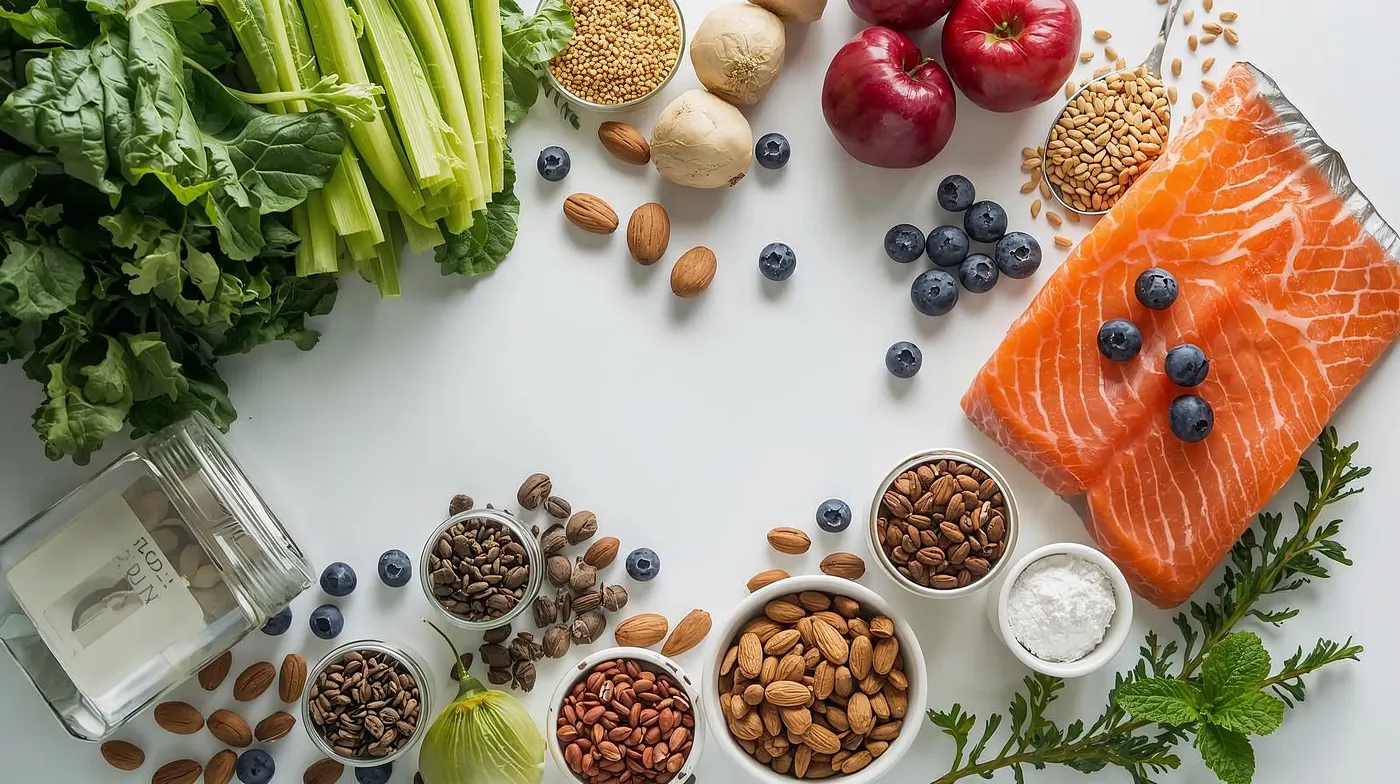
Which means a low-carb eater has to build fiber back in deliberately, from a much shorter list, or they will not get there. Non-starchy vegetables, avocado, nuts, seeds, berries in modest amounts, and — if you want the shortcut — a viscous fiber like psyllium. Nobody drifts into 25 grams of fiber on keto. It has to be constructed.
I had not constructed it. I had assumed that because my food was unprocessed and vegetable-heavy, the fiber was taking care of itself. That assumption was doing a lot of unexamined work.
What makes this worth writing about rather than fixing quietly is that it is the exact failure mode I spend my working life trying to catch. In platform engineering, the outages that hurt are almost never in the system you are watching. They are in the dependency nobody owns — the thing that has worked so long it stopped appearing on anyone's dashboard, so no alarm exists for it, so its degradation is invisible until it is an incident.
Fiber was my unowned dependency. It never showed up on the sheet because the sheet was designed around a different question, and a metric that isn't on the dashboard can drift to zero without anyone noticing. I have said a version of that sentence in review meetings for twenty years. It turns out I had been living the counterexample.
Fiber is not a carbohydrate your body absorbs, so adding it does not threaten ketosis — total carbs go up, net carbs largely don't. The practical build: a large volume of non-starchy vegetables at two meals, a daily serving of nuts or seeds, half an avocado, and berries if they fit your ceiling. That gets most people into the twenties. If it doesn't, a viscous fiber taken with plenty of water closes the gap and brings an LDL benefit with real trial evidence behind it.
What I would not do is chase 50 grams on keto. You would have to eat a volume of vegetables that crowds out protein, and the evidence you would be chasing does not exist.
Fiber Is Not One Thing
Most of the confusion here comes from treating fiber as a single substance with a single dose. It isn't. It is a category defined by what your small intestine can't digest, and its members behave completely differently.
- Viscous fibers — psyllium, oat and barley beta-glucan, guar gum, konjac — form a gel in water. This group has the cleanest randomised evidence: they slow carbohydrate absorption, blunt glucose response, and lower LDL. A systematic review comparing viscous with non-viscous cereal fibers found the LDL effect belonged specifically to the viscous ones.
- Fermentable fibers — inulin, resistant starch, the fiber in beans and onions — feed colonic bacteria. This is where the gas comes from, and where most of the microbiome enthusiasm points. The mechanism is real. The human outcome evidence is thin.
- Bulking fibers — wheat bran, cellulose, the structural fiber in vegetables — mostly pass through, holding water and adding stool bulk. Useful for regularity. Also the group that failed the colorectal adenoma trials.
Most whole foods contain a mix, which is a decent argument for getting fiber from food rather than one isolated source. It is also why "how much fiber" is a slightly wrong question. Thirty grams of wheat bran and thirty grams of mixed fiber from beans, greens, seeds and oats are not the same intervention, and the research does not treat them as such.
The one place fiber has genuinely convincing randomised evidence for a metabolic outcome is glycaemic control. A 2020 systematic review and meta-analysis in PLOS Medicine — Reynolds again — pooled trials in adults with prediabetes or diabetes and found higher fiber intakes reduced HbA1c by 2.00 mmol/mol (95% CI −3.30 to −0.71, across 33 trials) and fasting plasma glucose by 0.56 mmol/L, along with improvements in insulin, HOMA-IR, LDL, triglycerides, body weight and C-reactive protein.
I want to be honest about the size of that. Two mmol/mol is roughly 0.18 percentage points of HbA1c. It is real, it is randomised, and it is modest. It is not a drug. It is the kind of effect that matters because you do it every day for twenty years, which is the only way anything in this practice has ever mattered.
It's not a drug. It's the kind of effect that only matters because you do it every day for twenty years.
Why This Question Sharpens After 40
There is a genuine reason this is a 40-plus conversation and not a general-wellness one, and it has nothing to do with metabolism slowing down.
The American Cancer Society's 2026 statistics report describes colorectal cancer moving in two directions at once: continuing to decline in older adults, rising in adults under 65. It is now the leading cause of cancer death in adults under 50. Three in four cases in that younger group are diagnosed at regional or distant stage, when treatment is much harder. The ACS reaffirmed in 2026 that average-risk adults should begin screening at 45 and continue to 75 — and found that only about a third of adults aged 45 to 49 are up to date.
I need to be careful here, because this is where a health article usually cheats. The ACS lists possible contributors to the rise — obesity, sedentary living, alcohol, ultra-processed diets, changes to the gut microbiome, environmental exposures. Those are hypotheses under investigation. Low fiber intake is not established as a cause, and given that the fiber trials failed on adenoma recurrence, I am not going to imply that a bowl of lentils is your defence.
The actionable finding in that paragraph is not about fiber at all. It is the screening number. If you are 45 or over and have not been screened, that is the highest-value thing on this entire page, and it outranks every dietary change I could suggest by a distance that isn't close.
That is the honest hierarchy: get screened, then eat well. Not the other way round, and not instead.
How to Add It Without Wrecking Your Week
The most common way this goes wrong is not undereating fiber. It is deciding on a Sunday to fix it entirely by Tuesday.
Fiber that reaches your colon undigested gets fermented, and fermentation makes gas. Go from 15 grams to 40 in three days and you will be bloated, uncomfortable and convinced something is wrong with you. The Cleveland Clinic and the NIDDK give the same advice, and it is the right advice: increase gradually — commonly framed as 3 to 5 grams every few days, spread over two to four weeks.
Adaptation is real and reasonably quick. An analysis of three bean-feeding studies found participants' gas complaints returned toward baseline within about three to four weeks of the beans staying in the diet. The discomfort is a transition, not a verdict.
Two mechanical points that matter more than they sound:
- Water is not optional. Fiber works by holding water. Add fiber without adding fluid and you can turn a regularity problem into a worse one — doubly true on keto, where you already run lower on retained water.
- Timing changes what it does. Viscous fiber taken with a meal slows that meal's carbohydrate absorption. Between meals it mostly does bulking work. If you are using psyllium for the glucose or LDL effect, take it with food.
And one piece of folk wisdom worth killing, because a lot of people over 50 still follow it: the instruction to avoid nuts, seeds, corn and popcorn if you have diverticular disease was never based on evidence. In 2008, JAMA published an analysis of 47,228 men aged 40 to 75 from the Health Professionals Follow-up Study, tracked from 1986 to 2004. Nut, corn and popcorn consumption was not associated with increased risk of diverticulitis or diverticular bleeding. If anything it ran the other way — nuts at least twice a week, 20% lower risk; popcorn, 28% lower. That is observational and should be read as such, but the harm claim it replaced had nothing behind it at all. If your clinician has given you instructions for an active flare, follow them. The blanket lifetime ban is a myth.
The target is 25 to 29 grams a day, from food, and almost nobody hits it — the average American adult runs around 17. Getting from 17 to 27 is worth doing: the observational evidence linking it to lower mortality is large and consistent, and the randomised evidence for glycaemic control and LDL is real if modest. What is not established is nearly everything the current trend asserts. Fiber failed to prevent colorectal adenoma recurrence in two randomised trials. A high-fiber diet did not increase microbiome diversity or lower inflammatory markers in the trial that tested it directly. Isolated fibers are not interchangeable with fiber in food. And there is no evidence base for 50 grams — that number came from the internet, not the literature. Build to the high twenties, from whole foods, over a month rather than a weekend. Then stop, and go get screened.
Building fiber back into a low-carb week without wrecking your macros.
Generate a meal to your targets →What I'd Actually Do
- Count it once. Not forever — once, over a normal week. Most people, and nearly everyone eating low-carb, are wrong about their own number. You cannot reason about a dose you have never measured.
- Aim for the high twenties, not fifty. Twenty-five to twenty-nine grams is where the evidence is densest. Above that you are extrapolating; below twenty is where most of the population — and most of the risk signal — sits.
- Get it from food first. The mortality evidence is built on intrinsic fiber in whole foods, not isolated fiber added to products. Vegetables, nuts, seeds, and — if you eat them — beans and whole grains.
- If you're low-carb, construct it deliberately. Keto removes grains, legumes and most fruit, which is where most people's fiber comes from. Non-starchy vegetables at two meals, nuts or seeds daily, avocado, modest berries. It will not happen by accident.
- Use a viscous fiber for a specific job, not as a general tonic. Psyllium and oat beta-glucan have randomised evidence for LDL. Take them with a meal, with water. Don't expect them to deliver the cohort-study benefits.
- Ramp over weeks. Three to five grams every few days, two to four weeks to arrive. Add fluid at the same time. The gas settles within about a month; the crash diet version does not.
- Book the screening. If you're 45 or over and haven't been screened for colorectal cancer, that single action outweighs everything else on this page. Only about a third of 45-to-49-year-olds are up to date.
This is one person reading the literature and adjusting his own practice, not medical advice. Increasing dietary fiber gradually is safe for most adults — but see a clinician before making a significant change, and promptly if any of the following apply:
- Blood in your stool, black or tarry stools, or bleeding from the rectum
- A persistent change in bowel habit lasting more than a few weeks, or stools that have become consistently narrow
- Unintended weight loss, new persistent fatigue, or unexplained anaemia
- Abdominal pain that is severe, localised, or accompanied by fever
- A known stricture, bowel obstruction, gastroparesis, inflammatory bowel disease, or a history of bowel surgery — added bulk can be genuinely dangerous with these
- Difficulty swallowing, or any condition affecting swallowing — viscous fiber powders carry a choking and obstruction risk if taken with too little fluid
- You take medication on a tight schedule — fiber can alter absorption, so separate doses by a couple of hours and ask your pharmacist
A family history of colorectal cancer or polyps means your screening should start earlier than 45. That is a conversation to have now rather than at your next physical.
The thing I most want to leave you with: the interesting move here is not the last five grams. It is the first ten, which is where nearly everybody still is.