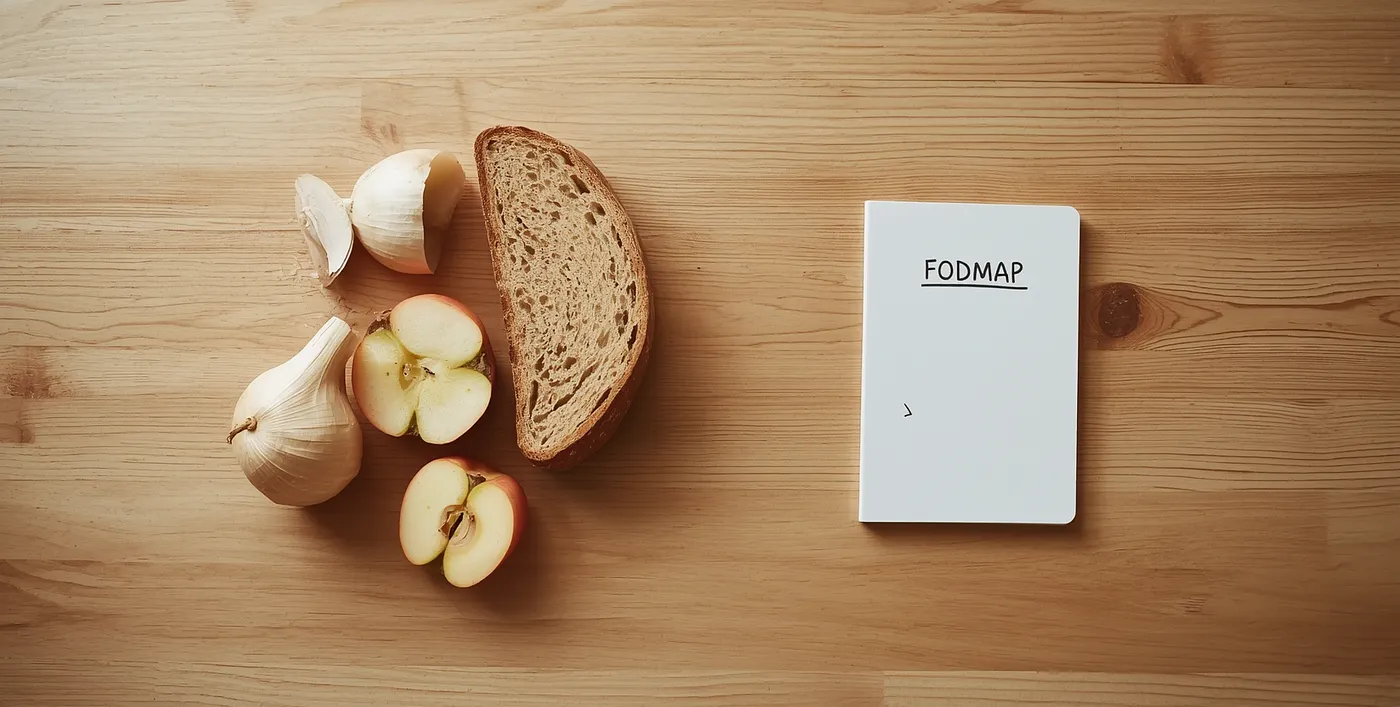
Bread, I decided, was the enemy.
It was the obvious villain. I'd feel fine in the morning, eat a sandwich at lunch, and by 3 p.m. look like I'd swallowed a basketball. The internet agreed: gluten, clearly. So I went gluten-free, and for about two weeks I felt vindicated. Lighter. Smug, even.
Then the bloating came back.
So I cut dairy. Then beans. Then onions, then apples, then anything cruciferous, then — at my lowest — most things that weren't rice, chicken, and a deep sense of grievance. I was eating maybe a dozen foods. And I was still bloated.
It took me an embarrassingly long time to realize I'd done the whole thing backwards. I wasn't running an experiment. I was running a panic.
Here's what I learned when I finally did it like a person who reads the studies.
First, The Unglamorous Truth About What Makes Gas
Most "mystery" bloating isn't a mystery. It's chemistry.
A big share of it comes from a group of carbohydrates with an ugly acronym: FODMAPs — fermentable oligosaccharides, disaccharides, monosaccharides, and polyols. Think the fructans in wheat, onion, and garlic; the lactose in dairy; the excess fructose in apples and honey; the polyols in stone fruit and sugar-free gum.
The mechanism is genuinely settled, not influencer-speak. These carbs are poorly absorbed in the small intestine, so they do two things: they pull water in osmotically, and they travel down to your colon where bacteria ferment them into hydrogen, carbon dioxide, and methane.
Water plus gas equals distension. Distension is the basketball.
Most "mystery" bloating isn't a mystery. It's chemistry — water pulled in, gas fermented out.
This is also where I have to correct my younger, frantic self on fiber. Fiber isn't a single hero or a single villain. Some fibers — the fermentable ones like inulin and certain resistant starches — can genuinely crank up gas. Others improve transit and quiet things down. So the honest statement isn't "fiber causes bloating." It's some fibers and FODMAP-rich foods do, in some people. Which brings us to the part I got most wrong.
The Mistake Almost Everyone Makes
Eliminating food feels productive. It feels like control. It is, mostly, a way to slowly make your life smaller while learning nothing.
The problem with cutting things one at a time, forever, based on vibes is that you never get a clean signal. You drop gluten and feel better — but was it the gluten, or the giant fermentable lunch you also stopped eating? You feel worse on Tuesday — was it the dairy, or the deadline?
And there's a quieter cost. The more plants I cut, the less varied my diet got — and plant variety is one of the better-supported levers for a diverse gut microbiome.
I wasn't allergic to food. I was allergic to eating fewer than a dozen things.
The American Gut Project found that people eating 30 or more different plants a week tended to have more diverse microbiomes than people eating 10 or fewer. I want to be careful here, because this is where a lot of writers oversell: that's an association, not proof that diversity itself cures anything. A varied-plant eater also tends to sleep, move, and live differently. But "eat a wider range of plants" is about as low-risk and well-supported as gut advice gets — and I was doing the exact opposite.
The Protocol I Should Have Run on Day One
There's an actual tool for this, and it's not a forever diet. It's a diagnostic.
The low-FODMAP protocol, developed at Monash University and now backed by clinical guidelines, has three phases — and only one of them is restriction:
- Elimination — cut high-FODMAP foods for a short window, typically 2–6 weeks, to get a quiet baseline.
- Reintroduction — add FODMAP groups back one at a time, methodically, to see which ones actually provoke symptoms and at what dose.
- Personalization — rebuild the broadest possible diet that keeps you comfortable.
The reason it's explicitly not meant to be permanent is itself evidence-based: staying in strict elimination starves your beneficial bacteria of the fermentable fiber they thrive on. The restriction is the flashlight, not the destination.
Low-FODMAP isn't a diet. It's a flashlight. The point is to turn it off.
The Plot Twist: It Was Never the Gluten
When I finally did the reintroduction properly — one group at a time, tracked, dosed — the result was almost funny.
Gluten-containing grains, reintroduced on their own, were fine. What lit me up like a switchboard was fructans: the FODMAP that happens to live in wheat and in onion and garlic. For two years I'd blamed the gluten in my sandwich. The actual culprit was partly the bread's fructans — and, far more than I expected, the onion and garlic in nearly everything savory I ate.
That's not a quirk. It's one of the most common reveals in this whole process: people are sure it's gluten, eliminate it, feel better, and never realize they also stripped out a pile of fructans at the same time. Correlation wearing a convincing disguise.
It was never the gluten. It was the company gluten keeps.
The win wasn't a shorter list of foods. It was a longer one. Dairy, beans, apples, most of what I'd banished — back on the menu. I just got specific about onion and garlic, and learned that garlic-infused oil gives me the flavor without the fructans (they're not oil-soluble). My diet got bigger, not smaller. That's the whole point I'd been missing.
The trick only works if the oil is genuinely infused and strained — garlic flavor carried into the oil, with no garlic solids left in the bottle. Fructans aren't oil-soluble; they stay behind in the solids. So a clear, strained infused oil gives you the flavor without the FODMAP. Skip anything with garlic pieces floating in it.
To make your own: warm a few peeled cloves gently in olive oil over low heat for a few minutes, then remove every piece of garlic completely. You're after the perfume, not the pulp. One safety note: garlic in oil is a low-acid food in an oxygen-free environment — the conditions C. botulinum likes. Refrigerate homemade infused oil, keep it only a few days, and toss it if unsure. Commercial versions are acidified for shelf stability; yours is not.
The Part Nobody Puts in a Supplement Ad: Your Brain Is in This
Here's something I dismissed as a cop-out until the research changed my mind.
The gut–brain axis is real and physiological — not a polite way of saying "it's in your head." Stress measurably changes gut motility, shifts the microbial environment, and — critically — turns up visceral sensitivity, meaning a totally normal amount of gas can register as genuine pain.
The clincher for me: gut-directed hypnotherapy and cognitive behavioral therapy have real randomized-trial support for IBS symptoms. That only makes sense if the wiring between stress and gut is functional, not metaphorical. My worst weeks were always my most stressed ones. I'd assumed that was coincidence. It wasn't.
About "Leaky Gut" — The Honest Version
This one needs splitting in two, because both the believers and the eye-rollers are half right.
Increased intestinal permeability is a real, measurable thing. It's genuinely involved in conditions like celiac disease and inflammatory bowel disease. That part is not woo.
What's overstated — sometimes to the point of myth — is the wellness-market version: that "leaky gut syndrome" is the hidden cause of fatigue, brain fog, and autoimmunity in otherwise healthy people, and that you can patch it with a powder. The causal direction is usually murky (permeability often looks like a consequence of disease, not the trigger), and the supplement claims are largely unsupported. Real biology; oversold cure.
Intolerance Is Not Allergy — and the Difference Matters
Quick, because people conflate these and it cuts both ways:
- A food allergy is an immune (IgE) reaction. It can be fast and dangerous. This is not the territory for self-experiments.
- A food intolerance is non-immune — either enzymatic (like lactase deficiency) or osmotic/fermentative (FODMAPs). Uncomfortable, not life-threatening.
Bloating from a sandwich is almost always the second kind. But because the words get blurred, some people panic over an intolerance and others wave off a real allergy. Worth getting straight.
Most everyday bloating is mechanical and dietary, not mysterious — gas and water from fermentable carbs, amplified by stress and by how sensitive your gut happens to be. The fix usually isn't less food forever; it's a short, structured elimination followed by careful reintroduction to find your specific triggers, then the widest comfortable diet you can build. "Leaky gut" cures and most blanket probiotic promises are running ahead of the evidence. And the trigger you're certain about may not be the real one — I'd have bet my house on gluten and lost.
See how this fits into a simple, evidence-based daily stack.
See the ingredient stack →What I'd Actually Do
- Rule out the serious stuff first (see below). Don't start with diet if there are red flags.
- Stop the random elimination. One-off cuts based on a bad day teach you almost nothing.
- Run the protocol properly, ideally with a dietitian — short elimination, then structured reintroduction. The reintroduction is where the actual answer lives. Skipping it is the mistake I made for two years.
- Reintroduce to expand, not restrict. The goal is the biggest diet you tolerate, not the smallest.
- Widen your plants over time — variety is a low-risk bet, and it's the opposite of what panic tells you to do.
- Treat stress as a gut variable, not a personal failing. If symptoms track your worst weeks, that's a real signal worth acting on.
- Be skeptical of anything sold as a gut "reset." If a powder promises to heal a leak you were never shown you have, keep your money.
A note on probiotics, since someone always asks: the effects are strain-specific and the evidence is genuinely mixed. Some strains help some people with some symptoms. That's not nothing — but it's not the blanket cure the label implies.
Everything above is the story of one person figuring out ordinary bloating, not medical advice. Bloating is usually benign, but some symptoms mean you should see a clinician before doing any self-directed diet experiment:
- Unintended weight loss
- Blood in your stool, or black/tarry stools
- Iron-deficiency anemia
- Symptoms that wake you from sleep
- Difficulty or pain swallowing
- Persistent vomiting
- New digestive symptoms starting after about age 50
- A family history of celiac disease, IBD, or GI cancer
If any of those are in the picture, that's a doctor's office, not a meal-tracking app.
The thing I most wish I'd known: the answer was never going to come from subtracting. It came from testing — and then from eating more, not less.