TThere was a moment in my training life when I realized I had been measuring effort wrong.
For years, I thought a good workout had to look active.
Reps. Sets. Sweat. Movement. Weight going up. Weight coming down. The burn of intensity. The satisfaction of feeling like I had conquered something.
Then one day, almost by accident, I held a wall sit.
No weights.
No machines.
No complicated program.
Just my back against the wall, knees bent, thighs parallel, hands off my legs, trying to keep my breathing calm.
At first, it felt almost silly.
This is it?
Twenty seconds later, my legs started whispering.
Thirty seconds later, they started arguing.
Forty seconds later, they were negotiating with my mind.
By one minute, I was no longer laughing. My quads were shaking. My posture wanted to collapse. And the most interesting part was this:
I was not moving at all.
That was the first time I understood the hidden power of isometric holds.
They look still from the outside.
But inside the body, everything is working.
The Strange Strength of Not Moving
An isometric hold is when your muscles create force without visible movement.
You are not lifting, lowering, curling, pressing, jumping, or running.
You are holding tension.
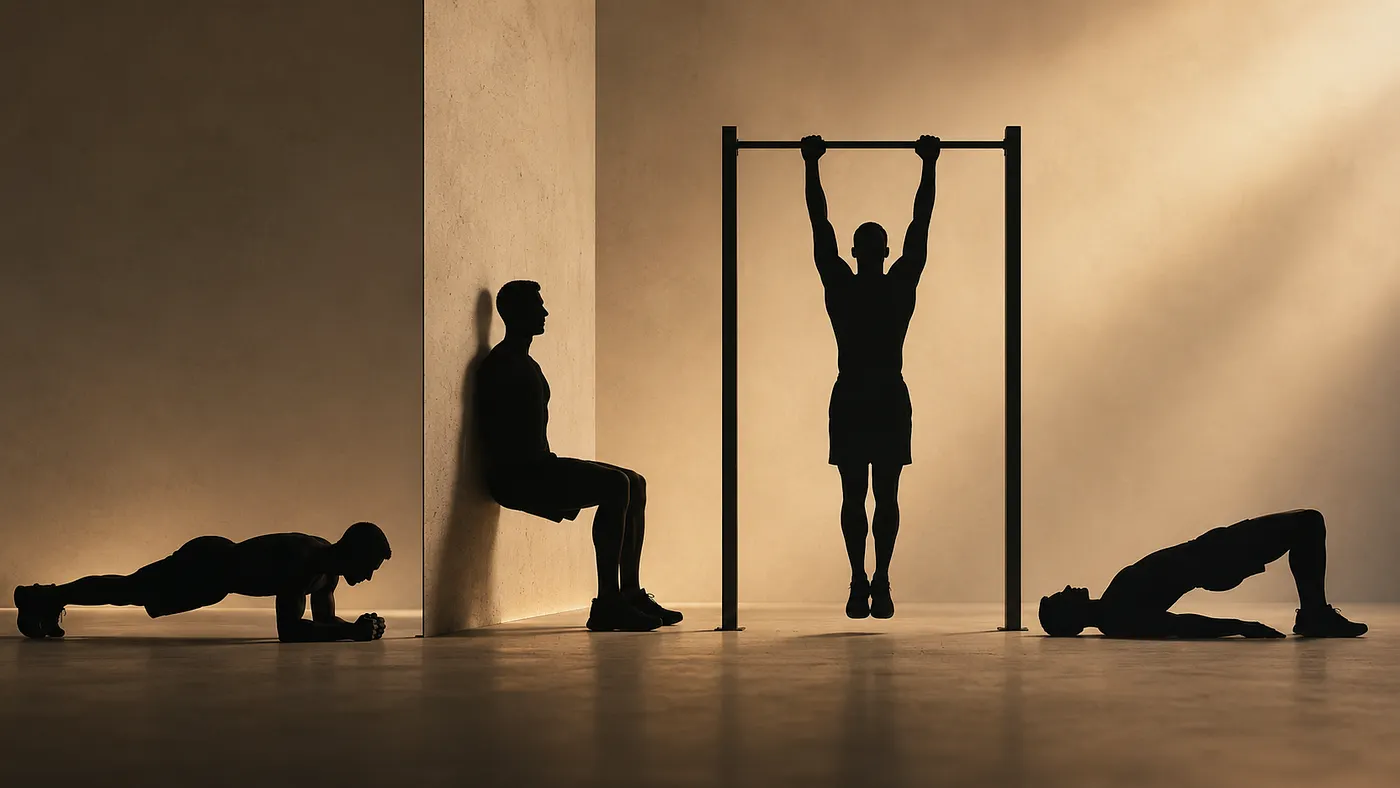
A plank.
A wall sit.
A dead hang.
A paused squat.
A glute bridge hold.
The bottom of a push-up.
The position stays mostly still, but the muscles are working hard to keep you there.
That is what makes isometrics so fascinating.
They reveal what movement can hide:
Can you actually own the position?
It is one thing to squat quickly. It is another to pause at the hardest point and stay there.
It is one thing to do push-ups with momentum. It is another to hold halfway down without collapsing.
It is one thing to say your core is strong. It is another to hold a clean plank while breathing calmly.
Isometrics remove the escape route of speed.
They make the body tell the truth.
Why the Body Responds So Strongly
The body is not only built through motion. It is built through tension.
When you hold a difficult position, your nervous system has to recruit muscle fibers and keep them active. Your stabilizing muscles have to participate. Your joints have to remain organized. Your breathing has to stay controlled. Your mind has to stay focused.
There is no momentum to save you.
No bouncing.
No swinging.
No rushing through the hard part.
This is why isometric holds can feel surprisingly intense. They force your body to create strength in a very specific position.
And often, that specific position is exactly where weakness lives.
The bottom of the squat.
The middle of the push-up.
The top of the glute bridge.
The hanging position for grip and shoulders.
The side plank position for the obliques and hips.
These are the places where the body either builds control or exposes compensation.
The First Lesson: Strength Is Control
One of the biggest mistakes in fitness is confusing movement with control.
Finishing a rep does not always mean you mastered it.
Sometimes, you are just moving through weakness quickly.
You may be able to squat, but can you pause at the bottom without your knees collapsing?
You may be able to do a push-up, but can you hold halfway down without your hips sagging?
You may be able to deadlift, but can you brace, breathe, and keep posture under tension?
Isometrics slow everything down.
They turn exercise into a conversation with the body.
And the body answers honestly.
Isometric Holds Build Real Strength
There is a common misconception that isometrics are only for beginners, rehab, or warm-ups.
They are not.
Done well, they can be brutally effective.
When you hold tension in one position, the muscles are forced to keep producing force. That builds strength exactly where the body is being challenged.
A wall sit trains the legs.
A paused squat builds lower-body control.
A push-up hold challenges the chest, shoulders, triceps, and core.
A dead hang builds grip and shoulder endurance.
A farmer’s hold trains posture, core, traps, hands, and mental grit.
That is the beauty of isometrics.
They do not always require more equipment.
Sometimes the upgrade is not more weight.
Sometimes the upgrade is more honesty.
The Second Lesson: Your Weakest Position Matters
Most injuries do not happen when everything is perfect.
They happen when fatigue shows up and control disappears.
The knee drifts.
The shoulder loses position.
The spine softens.
The core quits early.
Isometric holds train the body at those vulnerable points.
They teach joints to stay stable, muscles to support structure, and the nervous system to stay organized under pressure.
That is why they are so useful for the knees, hips, shoulders, ankles, wrists, and spine.
Not because they are magical.
Because they are controlled.
And control is often the missing link.
Tendons Love Controlled Tension
One of the most overlooked benefits of isometric holds is tendon resilience.
Muscles often adapt faster than tendons. That is one reason people can feel strong but still develop nagging issues around the knees, elbows, Achilles, or shoulders.
Tendons usually respond well to gradual, steady loading.
Isometrics provide that.
Instead of sudden impact or fast movement, the tendon experiences controlled tension. This can help build tolerance over time, especially when intensity is managed carefully.
The key is patience.
Effort is fine.
Shaking is fine.
Discomfort from work can be normal.
But sharp pain is not the goal.
Isometrics should feel like controlled challenge, not punishment.
The Third Lesson: Stillness Is Not Weakness
This is where isometrics became more than exercise for me.
During that wall sit, I realized my mind was being trained too.
Holding a hard position removes all distractions.
No momentum.
No fast reps.
No noise to hide behind.
Just breathing.
Shaking.
Staying.
Then the body starts negotiating:
This is uncomfortable.
You can stop now.
You already did enough.
And that is where the real training begins.
You learn to stay calm under tension.
That skill reaches far beyond the gym.
Life is full of isometric moments: waiting without quitting, leading under pressure, holding your values when things get hard, and staying composed when discomfort arrives.
In that sense, isometrics are not just strength training.
They are composure training.
Why Beginners Should Use Isometrics
For beginners, isometric holds are one of the safest and most useful ways to start building strength.
Many people struggle with movement quality at first. Squats feel awkward. Lunges feel unstable. Push-ups feel too hard. Core exercises feel confusing.
Isometrics simplify the task.
Instead of asking the body to move through a full range of motion immediately, you ask it to hold a position and learn control.
A beginner can start with:
Wall sits
Incline planks
Glute bridge holds
Chair-supported split squat holds
Farmer’s holds
Calf raise holds
Dead bug holds
These exercises build awareness.
And awareness is the beginning of good training.
Before you ask the body to move more, move faster, or lift heavier, you should ask one question:
Can you hold good position first?
Why Advanced Lifters Should Not Ignore Them
Advanced trainees need isometrics for a different reason.
They are strong enough to cheat.
Momentum can hide weakness. Dominant muscles can take over. Smaller stabilizers can stay asleep.
Isometric pauses expose those gaps.
Pause three seconds at the bottom of a squat.
Hold a curl halfway up.
Stop one inch above the floor in a push-up.
Hold the top of a pull-up.
Carry heavy dumbbells without letting posture collapse.
Suddenly, familiar exercises feel new again.
That is the beauty of isometrics.
They do not always add novelty.
They add depth to the basics.
The Core Was Built for This
If there is one area where isometrics shine, it is the core.
Most people still think core training means endless crunches.
But the core’s real job is not just to bend the spine.
The core helps resist movement. It protects the spine. It transfers force between the upper and lower body. It keeps you stable while your arms and legs move.
That is why planks, side planks, hollow holds, dead bug holds, loaded carries, and anti-rotation holds are so effective.
They train the core the way the body actually uses it.
A strong core is not just a six-pack.
A strong core is a quiet system of control.
The Best Isometric Holds to Start With
For the lower body, start with wall sits, squat holds, split squat holds, glute bridge holds, and calf raise holds.
For the core, use planks, side planks, hollow body holds, dead bug holds, and Pallof press holds.
For the upper body, use push-up holds, dead hangs, farmer’s holds, overhead holds, and towel row holds.
For posture, try wall angels, scapular retraction holds, chin tuck holds, and prone Y/T holds.
You do not need all of them.
You need a few done well.
A Simple Isometric Routine
Here is a simple routine that can be done three times per week.
Wall sit — 30 to 60 seconds
Incline or floor plank — 30 to 60 seconds
Glute bridge hold — 30 to 45 seconds
Farmer’s hold — 30 to 45 seconds
Split squat hold — 20 to 40 seconds per side
Repeat for 2 to 3 rounds.
Rest 30 to 60 seconds between exercises.
Keep your breathing slow.
Use an effort level around 7 out of 10. Hard, but controlled.
You should finish feeling trained, not destroyed.
If you want to experiment with more training ideas, I’ve added a simple Workout Generator on Eat Train Lead that includes isometric-style movements along with other strength and conditioning options: https://www.eattrainlead.com/train.html#workouts
The Breathing Rule Most People Miss
One of the biggest mistakes in isometric training is holding your breath.
As tension rises, many people brace hard and stop breathing. That only adds pressure and makes the hold feel harder than it needs to.
Instead, breathe through it.
Slow inhale.
Controlled exhale.
Steady posture.
Calm face.
The goal is not to survive the hold.
The goal is to stay organized under stress.
That is a different kind of strength.
When to Be Careful
Isometric holds can be powerful, but they should be used wisely.
If you have high blood pressure, heart concerns, dizziness, joint pain, recent surgery, or a medical condition, keep the intensity moderate and consult a qualified professional when needed.
Avoid maximal breath-holding efforts.
Stop if you feel chest pressure, sharp pain, lightheadedness, numbness, or unusual symptoms.
The goal is adaptation, not ego.
A good isometric hold should challenge you.
It should not scare your body.
The Hidden Gift of Isometrics
The more I used isometric holds, the more I realized they were teaching me something I had ignored for years.
Fitness is not always about doing more.
Sometimes it is about doing less, better.
Less movement.
More control.
Less speed.
More awareness.
Less ego.
More tension.
Less performance.
More presence.
In a world obsessed with motion, isometrics remind us that stillness can be productive.
The body does not only improve when it moves.
Sometimes the body improves when it learns not to collapse.
The ETL Takeaway
- Eat: Support the tissue you are asking to adapt. Protein, hydration, minerals, and recovery matter because muscles and tendons rebuild outside the workout.
- Train: Use isometric holds to build strength, stability, tendon tolerance, posture, and control. They are simple, but not easy.
- Lead: Isometrics teach a leadership lesson: progress is not always visible movement. Sometimes strength is built by holding steady under pressure.
Isometric holds are not a trend or a shortcut — they're the honest version of exercise that exposes exactly where your control breaks down. The research on tendon adaptation and the real-world experience of advanced lifters both point the same direction: if you're skipping holds, you're skipping the part that matters most. Build them in consistently, use good breathing, and they'll quietly fix the weak links that dynamic reps can't touch.
Final Thought
That first wall sit changed how I saw training.
It taught me that stillness is not passive.
Stillness can be work.
Stillness can be discipline.
Stillness can be strength.
Sometimes the simplest exercise reveals the most.
Because before you move stronger, you have to learn to hold stronger.
Disclaimer
This article is for general education only and is not medical advice.
Isometric holds can be effective, but they may not be suitable for everyone, especially if you have high blood pressure, heart conditions, joint pain, dizziness, recent surgery, or other medical concerns.
Start slowly, breathe through each hold, avoid maximal strain, and stop if you feel sharp pain, chest pressure, lightheadedness, numbness, or anything unusual.
Consult a qualified healthcare or fitness professional before starting or changing your exercise routine, especially if you have an existing condition.
Don't know what to do today? Generate a session that fits the time you have.
Generate a workout →What I'd Actually Do
- Add a 30-second wall sit at the end of every leg session — use it as a diagnostic. If you can't hold 60 seconds clean, that's the gap to close.
- Insert a 3-second pause at the hardest point of your main lifts (bottom of squat, halfway in push-up). It changes the movement immediately.
- Run the simple 5-exercise isometric routine 3x per week when travel, time, or equipment limits your options. No excuses needed.
- Practice breathing through holds, not holding your breath. Slow exhale out, controlled inhale in. That's where the composure training actually happens.
- If you have nagging knee, shoulder, or elbow issues, try isometric holds at the painful angle for 30–45 seconds daily for 2–4 weeks before adding more load. Tendons respond well to this.
- Talk to a clinician if you have high blood pressure, heart conditions, recent joint surgery, or dizziness — isometric holds elevate intra-abdominal pressure and aren't appropriate at high intensity for everyone.